

 Orders
 Addresses
 Payment methods








Details
| Product number: | 7070061 pdf |
|---|---|
| Arrangement: | Duet |
| Instruments: | Guitar , Piano , Vocal |
| Genre: | Oldies |
| Duet: | Piano, Voice & Guitar |
| Difficulty: | Medium |
| Experience: | Elementary (3–4 years) |
| Key: | F Major |
| Language: | German |
| Tempo: | 80 |
| Artist: | Richard , Cliff |
| Authors: | Leiber, Jerry , Stoller, Mike , Bradtke, Hans |
| Pages: | 5 |
| duration: | 02:47 |
| Publisher: | ND-Verlag |

Rote Lippen soll man küssen - Sheet Music for Piano and Vocals Cliff Richard








 100% Legal & Licensed
 Verified by Musicians
 No Subscription. One-Time Purchase.
 Instant Download after Purchase
Details
| Product number: | 7070061 pdf |
|---|---|
| Arrangement: | Duet |
| Instruments: | Guitar , Piano , Vocal |
| Genre: | Oldies |
| Duet: | Piano, Voice & Guitar |
| Difficulty: | Medium |
| Experience: | Elementary (3–4 years) |
| Key: | F Major |
| Language: | German |
| Tempo: | 80 |
| Artist: | Richard , Cliff |
| Authors: | Leiber, Jerry , Stoller, Mike , Bradtke, Hans |
| Pages: | 5 |
| duration: | 02:47 |
| Publisher: | ND-Verlag |
Product Description
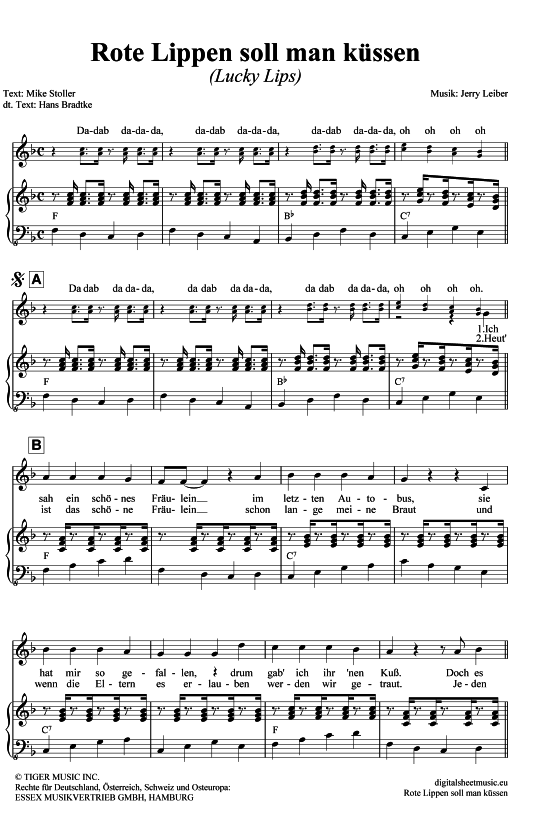
„Rote Lippen soll man küssen" is an instant crowd-pleaser in live performance — and the piano and vocal sheet music for this classic demands real technical control from around four years of study onward: large interval leaps and nimble runs require precision that has to be solid. As part of the playbackNOTEN series, the arrangement also integrates seamlessly into ensemble settings.
Piano & Vocal Sheet Music „Rote Lippen soll man küssen" – a spirited oldie for piano & voice
Cliff Richard brought this song to wide attention in the early 1960s. It is a German-language version of the rock 'n' roll classic by Jerry Leiber and Mike Stoller, adapted into German by Hans Bradtke. The lyrics tell of a fleeting encounter on a bus and the longing for something more — light, buoyant, with that unmistakable charm of the early Beat era. A song that puts you in a good mood immediately.
F major gives the piece its bright, open sound — entirely diatonic, meaning no harmonic surprises, which makes the entry point more accessible. The vocal line spans just over an octave and a half, frequently sitting in the middle to upper register — the voice needs genuine support there to keep the pitches from wavering. The piano accompaniment carries the flow and rhythm with a note density that never overwhelms the vocal line. From measure 45 onward, the piece shifts to C major — a fresh change of color that gives the song its momentum. The arrangement spans 61 measures in total.

- Vocal Range: C4 to F5 (1.5 octaves)
- Main Challenge: Several fast passages (runs / short note values), frequent large interval leaps (sixths and wider)
- Ideal for: Lessons, performances, and concerts — a crowd favorite from the oldie era
- Tempo: lively
Practicing the large interval leaps in the vocal line in isolation first — without piano accompaniment, simply keeping the root pitch in your ear — will make them considerably more reliable once you bring both parts together. The fast runs in the piano part settle best when worked through slowly, one hand at a time, before combining them. The short legato slurs — those small curved markings over individual note groups — deserve deliberate shaping: each phrase has its own breath. The piece also features clear dynamic contrasts; varying the piano touch and matching the voice dynamically transforms a solid run-through into a genuine performance. The shift to C major at measure 45 feels more natural if you anticipate it mentally a few bars ahead — that way it registers not as a break, but as an opening up.
A five-page scrollable score preview shows you exactly what to expect before you commit — no buying blind. If you'd like to hear the arrangement at tempo first, a short demo audio sample is available free of charge. A playback track — with or without melody, your choice — is also available as a separate option, ideal for practicing the vocal line. The sheet music is available for immediate download after purchase. 100% licensed — ready to perform legally, right away.
Editorially reviewed by the notendownload.com team
