

 Orders
 Addresses
 Payment methods




Details
| Product number: | NSF112ZG1 pdf |
|---|---|
| Arrangement: | Duet |
| Instruments: | Piano , Vocal |
| Genre: | Volkslied Traditionals |
| Duet: | Piano, Voice |
| Difficulty: | Medium |
| Experience: | Elementary (3–4 years) |
| Key: | G Minor |
| Language: | German |
| Tempo: | 82 |
| Authors: | Jugenheimer Liederblatt |
| Pages: | 1 |
| duration: | 3:26 |
| Publisher: | Notensatz S. Fischer |
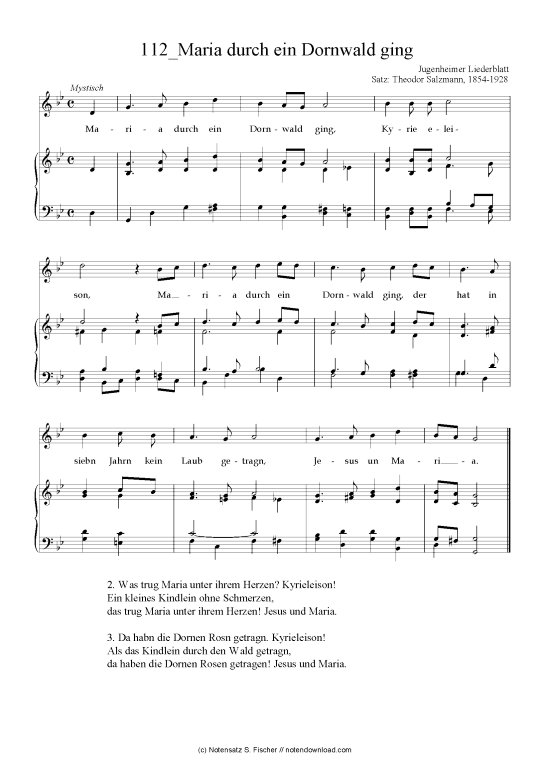
Maria durch ein Dornwald ging - Sheet Music for Piano and Voice Jugenheimer Liederblatt








 100% Legal & Licensed
 Verified by Musicians
 No Subscription. One-Time Purchase.
 Instant Download after Purchase
Details
| Product number: | NSF112ZG1 pdf |
|---|---|
| Arrangement: | Duet |
| Instruments: | Piano , Vocal |
| Genre: | Volkslied Traditionals |
| Duet: | Piano, Voice |
| Difficulty: | Medium |
| Experience: | Elementary (3–4 years) |
| Key: | G Minor |
| Language: | German |
| Tempo: | 82 |
| Authors: | Jugenheimer Liederblatt |
| Pages: | 1 |
| duration: | 3:26 |
| Publisher: | Notensatz S. Fischer |
Product Description
"Maria durch ein Dornwald ging" is one of the best-known German Advent and Christmas songs. These piano and vocal scores present it in an arrangement that is realistically accessible after approximately three years of lessons. The combination of position shifts in the left hand and a brisk tempo demands coordination, but also makes the piece tangible and satisfying to work through — whether in lessons, at an Advent concert, or in a church service.
Sheet Music "Maria durch ein Dornwald ging" – Ancient Advent Song for Piano & Voice
The song originates from the Jugenheimer Liederblatt, an early German song collection. It depicts Mary's journey through a thorny forest — an image that has been associated with the pre-Christmas season for centuries. The simple, haunting melodic line and the archaic tone of the text have secured the piece's enduring place in the repertoire. Its exact date of composition and origins remain obscure; the song is considered an anonymous folk song that spread widely through oral tradition and 19th-century song collections. In terms of genre, it sits between Marian hymn and Advent song: it carries the Marian imagery of medieval devotion, yet today it is sung predominantly in an Advent context — a dual identity that accounts for its distinctive character.
G minor gives the piece its serious, almost meditative quality. The 4/4 time signature lends the melody a steadily walking pulse that suits the archaic simplicity of the folk song well — phrases land naturally on strong beats, which aids orientation for both parts. The harmony moves across a small number of clearly defined degrees: the chord progression revolves essentially around Gm–Cm–D–Gm, that is, tonic, subdominant, and dominant in a pure minor cadence — with no modulations or chromaticism, which makes tonal orientation considerably easier. The vocal line sits in a middle to slightly elevated range — the pitch range extends from D4 to E♭5 (d' to e♭''), spanning 13 semitones. While not extremely wide, it includes moments in the upper register that require breath support to prevent the tone from breaking. The piano accompanies the voice, keeping it harmonically grounded and giving it space. The intermediate-level classification is justified by two specific characteristics: the left hand must shift position regularly while the right hand carries the melody — a demand for two-handed coordination that does not come automatically. Added to this is a brisk tempo that leaves little room for hesitation. The form is concise: twelve bars with an upbeat, clear and easy to keep in view.
- Pitch Range: d' to e♭''
- Main Challenge: Left-hand position shifts while the right hand maintains the melodic line
 |
Practicing the left hand in isolation first quickly reveals where the leaps occur — allowing you to target those specific passages before bringing both hands together. The vocal line remains manageable in range, but the upper register requires body support to keep the tone from sounding flat. Since the harmony remains entirely diatonic throughout, no tonal orientation needs to be developed — all energy can be directed toward coordinating the vocal line with the piano accompaniment. For ensemble performance, it is advisable to establish the tempo together at the piano: the pianist plays the first two bars as an introduction, and the singer breathes in on the final beat — this way both performers find the same pulse from the outset, without the need for counting. If you are unsure whether your chosen tempo is sustainable, play through the left hand alone at the target speed: if the position shifts come off cleanly, the tempo is realistic. The piece is well suited to Advent concerts, Christmas celebrations, and church services — its compact twelve-bar form also makes it quick to prepare.
A short demo audio sample is available — ideal for gauging tempo and character before purchasing. The sheet music is available for immediate download after purchase. 100% licensed — ready to perform legally, right away.
Editorially reviewed by the notendownload.com team
