

 Orders
 Addresses
 Payment methods




Details
| Product number: | 504-12 pdf |
|---|---|
| Arrangement: | Solo |
| Instruments: | Vocal |
| Genre: | Classical |
| Era: | 1730 1830 |
| Vocal: | Vocal and Chords |
| Difficulty: | Easy |
| Experience: | Beginner (1–2 years) |
| Key: | C Major |
| Language: | German |
| Tempo: | 120 |
| Authors: | Möller, F.W. |
| Pages: | 1 |
| duration: | 03:12 |
| Publisher: | ND-Verlag |
Mein Vater war ein Wandersmann - Sheet Music for Vocal F.W. Möller/S. u. E. Möller








 100% Legal & Licensed
 Verified by Musicians
 No Subscription. One-Time Purchase.
 Instant Download after Purchase
Details
| Product number: | 504-12 pdf |
|---|---|
| Arrangement: | Solo |
| Instruments: | Vocal |
| Genre: | Classical |
| Era: | 1730 1830 |
| Vocal: | Vocal and Chords |
| Difficulty: | Easy |
| Experience: | Beginner (1–2 years) |
| Key: | C Major |
| Language: | German |
| Tempo: | 120 |
| Authors: | Möller, F.W. |
| Pages: | 1 |
| duration: | 03:12 |
| Publisher: | ND-Verlag |
Product Description
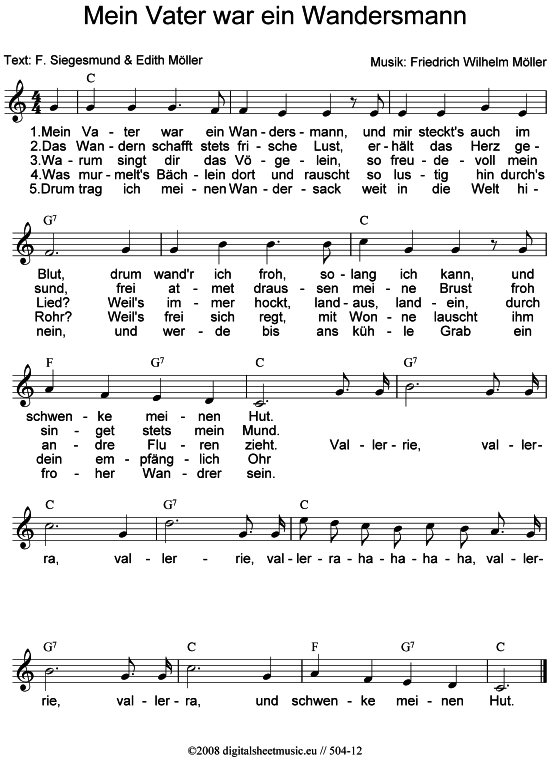
"Mein Vater war ein Wandersmann" sounds instantly familiar — and works beautifully as a lead sheet. The sheet music is well suited for singers who already have a grounding in basic breath technique and phrasing: if you can sustain a melodic line steadily across several bars, you'll feel right at home here. The brisk tempo of 120 BPM keeps the melody moving while remaining very approachable.
Sheet Music "Mein Vater war ein Wandersmann" – a cheerful hiking song as a lead sheet
"Mein Vater war ein Wandersmann" is one of the best-known German-language folk songs. The text by F. W. Möller celebrates the joy of hiking and the desire to explore the world. Brooks babble, birds sing — the song conjures images that resonate immediately. The melody is catchy and sticks quickly. That's precisely what makes it such a rewarding piece for lessons and communal singing alike.
This lead sheet edition presents the melodic line with chord symbols — flexibly usable as a foundation for accompaniment or improvisation. The key of C major requires no accidentals, which lowers the barrier to entry considerably. The consistently diatonic writing — no harmonic digressions, no surprises — makes the arrangement genuinely accessible for beginners and gives the "Easy" difficulty rating a concrete basis. The melody spans just over an octave and a half (C4–E5), sitting in the middle to slightly upper vocal range. The 4/4 time signature gives the piece its characteristic marching momentum: four steady beats per bar that make the walking pace palpable. The form comprises 17 bars including the pickup — compact and easy to survey. The song belongs to the repertoire of 19th-century German folk music and has since established itself as a staple of school and choral singing.
- Vocal range: c' to e'' (1.5 octaves)
- Tempo: brisk and moving
 |
The greatest challenge lies in the long phrase that extends across nearly ten bars without a notated rest. In practical terms, it's worth planning a prepared breath no later than before bar 1 (after the pickup) and again before bar 9, just as the phrase gains momentum. Breath support — the controlled engagement of the airstream from the diaphragm — keeps the melody stable and clear across these long arcs. The passage in the upper part of the voice (around E5) calls for secure head voice; singers who approach it with a light onset rather than pushing will sound convincing from the very first run-through. The song is particularly well suited to individual and group lessons, as well as to communal singing settings where a familiar, rhythmically clear piece is called for. In group lessons, it's worth working through the long phrase together a cappella first: everyone sings through to bar 8, pauses, and the teacher marks the shared breath before bar 9 with a brief hand gesture — this helps the group develop a unified sense of phrasing before the accompaniment is added.
A short audio preview is available in advance, so you can hear the melody before downloading the sheet music. After purchase, the sheet music is available for immediate download. 100% licensed — ready to perform legally, right away.
Editorially reviewed by the notendownload.com team
