

 Orders
 Addresses
 Payment methods




Details
| Product number: | NSF29NM pdf |
|---|---|
| Arrangement: | Instrumentation with vocals |
| Instruments: | Choir |
| Genre: | Romantic |
| Era: | 19th Century |
| Choir: | Mixed choir |
| Difficulty: | Easy |
| Key: | C Major |
| Language: | German |
| Tempo: | 92 |
| Authors: | Glehn, Manfred von (1867-1924) |
| Pages: | 2 |
| duration: | 4:00 |
| Publisher: | Notensatz S. Fischer |
Du großer Gott, wenn ich die Welt betrachte - Sheet Music for mixed choir Komposition, Schwedische Volksweise / Manfred von Glehn, 1867-1924








 100% Legal & Licensed
 Verified by Musicians
 No Subscription. One-Time Purchase.
 Instant Download after Purchase
Details
| Product number: | NSF29NM pdf |
|---|---|
| Arrangement: | Instrumentation with vocals |
| Instruments: | Choir |
| Genre: | Romantic |
| Era: | 19th Century |
| Choir: | Mixed choir |
| Difficulty: | Easy |
| Key: | C Major |
| Language: | German |
| Tempo: | 92 |
| Authors: | Glehn, Manfred von (1867-1924) |
| Pages: | 2 |
| duration: | 4:00 |
| Publisher: | Notensatz S. Fischer |
Product Description
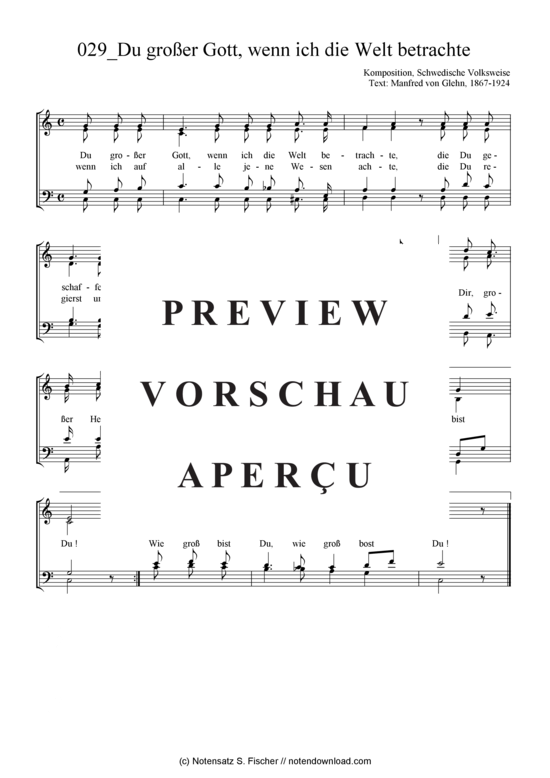
Choral sheet music for a solemn hymn – this arrangement of „Du großer Gott, wenn ich die Welt betrachte" is written for mixed choirs with approximately two or more years of singing experience. The homophonic choral texture – in which all voices move together rhythmically for the most part – makes the learning process considerably more straightforward, allowing even less experienced choirs to find a unified sound quickly.
Sheet Music for „Du großer Gott, wenn ich die Welt betrachte" – A Solemn Hymn for Mixed Choir
Manfred von Glehn (1867–1924) was a Baltic German composer and church musician. His hymn „Du großer Gott, wenn ich die Welt betrachte" – composed in the late 19th century and first disseminated within the Baltic German church music tradition – is a song of praise: the text turns its gaze toward creation and culminates in an expression of reverence before God. Contemplative hymn texts of this kind, which move from the vastness of the world to the greatness of its Creator, form a well-established part of the late 19th-century Lutheran choral repertoire. The sheet music is published by Notensatz S. Fischer.
The piece is set in C major – a key with no accidentals, offering singers of all voice parts a clear harmonic reference point. The harmony remains strictly diatonic throughout: no modulations, no unexpected chromatic passages. The 4/4 time signature gives the piece a calm, steady pulse that naturally produces four-bar phrases and clearly defines the breath arcs for all voices. The total range spans 15 semitones: the soprano reaches into the upper middle register, while the bass securely anchors the harmonic foundation – a range well within the grasp of experienced amateur choirs. The melody moves through a moderate to slightly elevated tessitura and requires solid breath support from the soprano in the upper register. The tempo is brisk yet singable. The "Easy" difficulty rating is well-founded: the texture remains clearly structured, and no voice part carries particularly demanding lines.
    |
Anyone looking to keep the soprano secure in the upper register should pay close attention to consistent breath support – particularly on sustained notes at the end of phrases. The bass carries the harmonic foundation in the lower register; conscious projection here is worthwhile to prevent the choir's lower end from dropping away. The alto moves within the inner voice structure, frequently taking third or fifth positions relative to the soprano melody – actively listening to the soprano line will help keep intonation clean. The tenor supports the harmonic middle ground; since it is often written in close proximity to the alto, it is worth working through the tenor line independently before bringing the full texture together. Because the setting is predominantly homophonic – all four voices generally moving forward together – the ensemble carries the piece as a whole. Conductors who set the tempo at around 92 BPM will find that the 4/4 meter unfolds with an even, flowing character that never feels rushed – a steady quarter-note pulse helps the choir breathe together and bring phrases to a clean close. Running through each voice part in isolation will quickly reveal that the individual lines are logical and genuinely singable. The piece is particularly well suited to church choirs and amateur choirs with a basic grounding in four-part singing who are looking for a short, resonant work for a service or devotional setting. The greatest challenge lies in maintaining clean intonation in the soprano's upper middle register; all other voice parts remain in comfortable territory. This piece is an ideal fit for church choirs and amateur choirs taking their first steps in four-part singing.
A short audio preview is available, giving you a sense of the piece's character before you purchase. Sheet music is available for immediate download after purchase. 100% licensed – ready to perform, legally, right away.
Editorially reviewed by the notendownload.com team
