

 Orders
 Addresses
 Payment methods




Details
| Product number: | NSF28GZ1 pdf |
|---|---|
| Arrangement: | Instrumentation with vocals |
| Instruments: | Choir |
| Genre: | Renaissance |
| Era: | 15th / 16th Century |
| Choir: | Mixed choir |
| Mixed Choir: | 3-part Mixed Choir |
| Difficulty: | Easy |
| Language: | German |
| Authors: | Staden , Johann (1581-1634) |
| Pages: | 2 |
| duration: | 02:27 |
| Publisher: | Notensatz S. Fischer |
Drei schöne Ding - Sheet Music for Mixed Choir SAT Johann Staden








 100% Legal & Licensed
 Verified by Musicians
 No Subscription. One-Time Purchase.
 Instant Download after Purchase
Details
| Product number: | NSF28GZ1 pdf |
|---|---|
| Arrangement: | Instrumentation with vocals |
| Instruments: | Choir |
| Genre: | Renaissance |
| Era: | 15th / 16th Century |
| Choir: | Mixed choir |
| Mixed Choir: | 3-part Mixed Choir |
| Difficulty: | Easy |
| Language: | German |
| Authors: | Staden , Johann (1581-1634) |
| Pages: | 2 |
| duration: | 02:27 |
| Publisher: | Notensatz S. Fischer |
Product Description
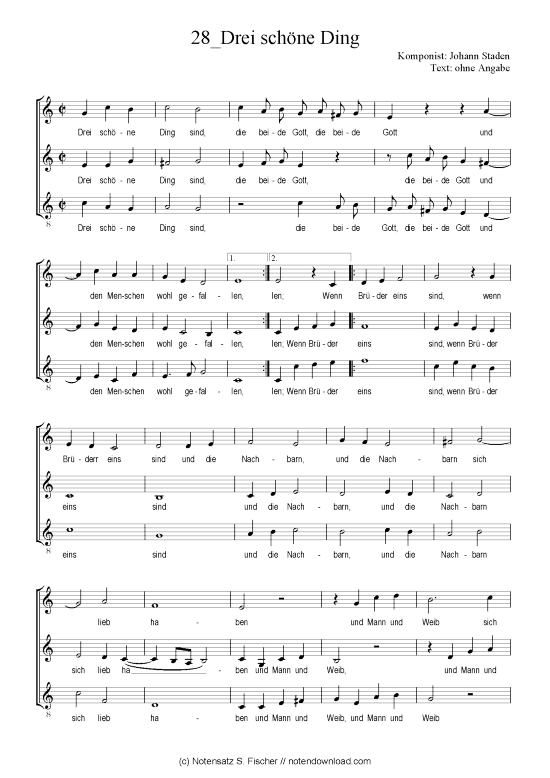
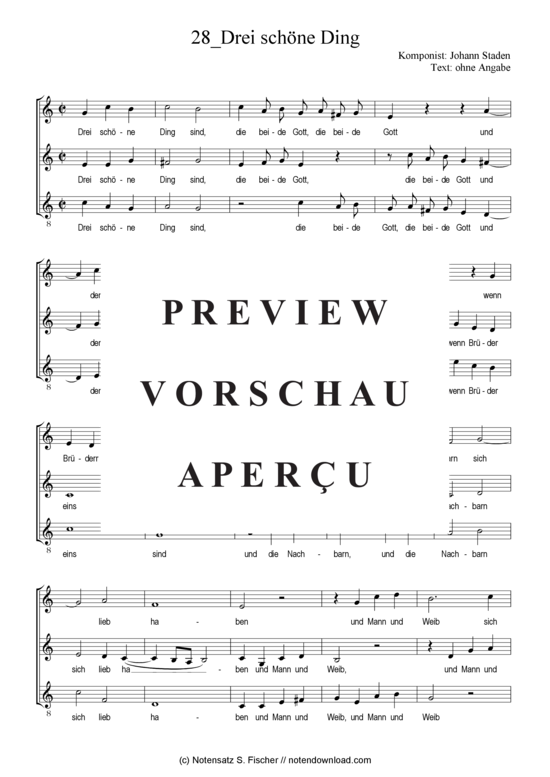
Choral sheet music for one of the Renaissance's most beloved texts — Johann Staden's "Drei schöne Ding" is well suited to choirs with roughly two or more years of shared experience. The largely homophonic choral writing — with all voices moving in step together — keeps the learning curve manageable and the musical effect immediately audible.
Choral Sheet Music "Drei schöne Ding" — Stately Renaissance Setting for Mixed Choir
Johann Staden lived and worked from 1581 to 1634, squarely within the flowering of German Renaissance music. He served as organist in Nuremberg and left behind an extensive body of vocal works. "Drei schöne Ding" draws on an Old Testament sentiment: brotherly love, good neighbourship, and harmony are presented as things that please God and humankind alike. The text is straightforward — and that simplicity is precisely what gives the music its clarity and memorability.
The piece is set in C major and moves throughout in a purely diatonic manner — no chromatic surprises, staying entirely within the natural scale. This gives the setting its calm, ceremonial character. In measure 11, the harmony briefly shifts to A minor — a detour that makes the brightness of C major shine all the more clearly upon its return. The melody spans a range of C' to D'' — fourteen semitones, just over an octave — and remains comfortably singable throughout. The repeated section across the piece's 26 measures provides a clear structure that choirs tend to internalize quickly.
- Ideal for: Choir rehearsal, school performance, church concert
- Tempo: Calm and flowing
- Main challenge: Tenor part — the voice sits comparatively high and requires solid breath support
 |  |
 |
Anyone who pays close attention to the tenor part from the outset will notice: it sits in a comparatively high register and demands solid breath support — a conscious engagement of breath pressure to keep the upper notes from losing focus. It's worth addressing this early on. A separate sectional rehearsal for the tenors before the full choir comes together makes a noticeable difference. The brief turn to A minor from measure 11 onward sounds its best when the choir pulls the dynamic back slightly there — then brightens again with the return to C major. The piece thrives on exactly these kinds of dynamic contrasts: crescendo and decrescendo not as a box-ticking exercise, but as the means of making the emotional arc audible.
The sheet music is available for immediate download after purchase. 100% licensed — ready to perform legally, right away.
Editorially reviewed by the notendownload.com team