

 Orders
 Addresses
 Payment methods




Details
| Product number: | cmus743ks pdf |
|---|---|
| Arrangement: | Solo |
| Piano: | Piano Easy |
| Key: | F Major |
| Language: | German |
| Tempo: | 96 |
| Time: | 2-4 |
| Authors: | Traditional |
| Pages: | 1 |
| arrangers: | Mus , Carsten (CM Music) |
| duration: | 0:50 |
| Publisher: | Carsten Mus |
Der Herbst ist da - Sheet Music for Solo Piano Traditional


 100% Legal & Licensed
 Verified by Musicians
 No Subscription. One-Time Purchase.
 Instant Download after Purchase
Details
| Product number: | cmus743ks pdf |
|---|---|
| Arrangement: | Solo |
| Piano: | Piano Easy |
| Key: | F Major |
| Language: | German |
| Tempo: | 96 |
| Time: | 2-4 |
| Authors: | Traditional |
| Pages: | 1 |
| arrangers: | Mus , Carsten (CM Music) |
| duration: | 0:50 |
| Publisher: | Carsten Mus |
Product Description
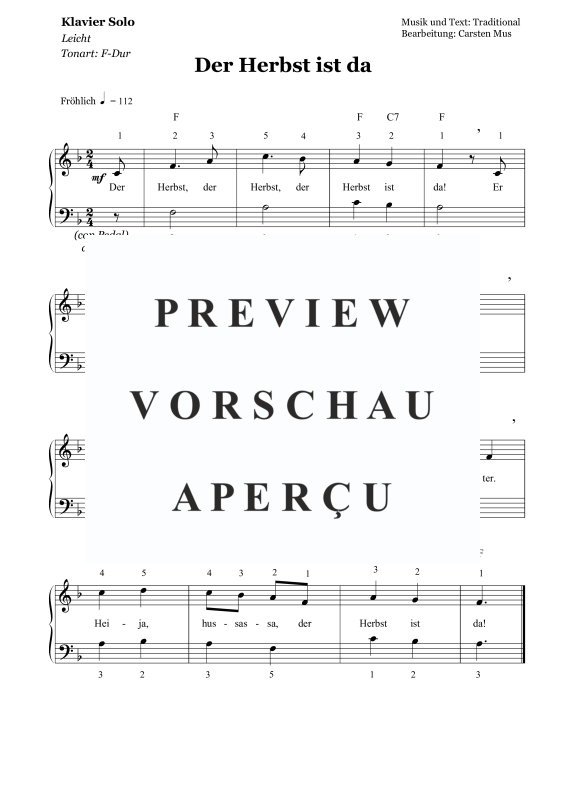
Autumn, wind and movement – "Der Herbst ist da" belongs to the classic German folk song repertoire. The piano sheet music is aimed at players with about one year of lessons: the melody's range spans just under two octaves and already in early learning stages requires simple coordination of both hands.
Sheet Music "Der Herbst ist da" – Lively Folk Song for Piano Solo and Keyboard
"Der Herbst ist da" is a traditional German folk song. The text describes the arrival of autumn with wind and falling leaves – brief and vivid. The typical exclamatory character of folk singing verses shapes the piece. The song has been handed down in German-speaking regions since the 19th century and is a fixed part of the educational song literature; it exists in numerous regional versions. This piano arrangement is by Carsten Mus and includes one verse of the song for singing along under the melody. Above the melody, chord symbols are also notated for orientation and for an accompanying instrument such as guitar or ukulele. The accompaniment mostly consists only of quarter and half notes. For learning purposes, the student can use the sustain pedal.
F major gives the piece a clear, bright basic color – ideal for a melody that pushes forward directly and without detours. The tempo is brisk, which matches the lively character of the song. The student should watch for a B-flat accidental in both hands. The melody stays in the middle register throughout and lies comfortably under the hand. Diatonic harmony – that is, no surprising accidentals – keeps the piece stable. The classification as easy is realistic: both hands must play together and require attention early on – but the position stays comfortable, and no shape lies outside the natural playing range. The melody voice benefits from clear legato playing within the phrases, while at the verse boundaries a short release underlines the folk song character and makes the structure audible for listeners. The fingerings in both hands help the student play the song smoothly. An audio recording (mp3) is additionally available.