

 Orders
 Addresses
 Payment methods




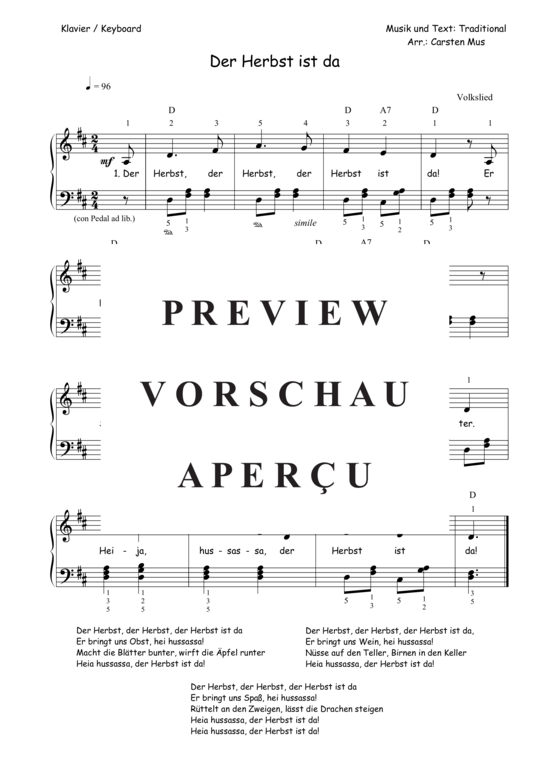
Details
| Product number: | CMUS373KS pdf |
|---|---|
| Arrangement: | Solo |
| Instruments: | Piano |
| Genre: | Volkslied Traditionals |
| Piano: | Piano Solo |
| Difficulty: | Advanced |
| Experience: | Beginner (1–2 years) |
| Key: | D Major |
| Language: | German |
| Tempo: | 96 |
| Time: | 2-4 |
| Authors: | Traditional , Mus, Carsten Arr. |
| Pages: | 1 |
| arrangers: | Mus , Carsten |
| duration: | 2:18 |
| Publisher: | Carsten Mus |
Der Herbst ist da - Sheet Music for Piano Solo Traditional








 100% Legal & Licensed
 Verified by Musicians
 No Subscription. One-Time Purchase.
 Instant Download after Purchase
Details
| Product number: | CMUS373KS pdf |
|---|---|
| Arrangement: | Solo |
| Instruments: | Piano |
| Genre: | Volkslied Traditionals |
| Piano: | Piano Solo |
| Difficulty: | Advanced |
| Experience: | Beginner (1–2 years) |
| Key: | D Major |
| Language: | German |
| Tempo: | 96 |
| Time: | 2-4 |
| Authors: | Traditional , Mus, Carsten Arr. |
| Pages: | 1 |
| arrangers: | Mus , Carsten |
| duration: | 2:18 |
| Publisher: | Carsten Mus |
Product Description
Autumn, wind, and movement – „Der Herbst ist da" belongs to the classic German folk song repertoire. This piano arrangement is aimed at players with approximately two years of lessons: the melodic range spans just under two octaves and calls for reliable coordination of both hands from an early stage.
Sheet Music „Der Herbst ist da" – lively folk song for piano solo
„Der Herbst ist da" is a traditional German folk song. The text depicts the arrival of autumn with wind and falling leaves – concise and vivid. The piece is shaped by the characteristic exclamatory quality of folk verse. The song has been passed down in German-speaking regions since the 19th century and is firmly established in the pedagogical song repertoire; it exists in numerous regional variants. This piano arrangement was made by Carsten Mus and encompasses four verses. The accompaniment works with broken chords – a figure that gives the piece a sense of flow without overloading the melody.
D major gives the piece a clear, bright tonal character – ideal for a melody that moves forward directly and without detour. The tempo is brisk, which suits the lively nature of the song. The melody stays consistently in the middle register and sits comfortably under the hand. Diatonic harmony – meaning no accidental surprises – keeps the piece grounded. The easy rating is realistic: both hands must work together, and the range of just under two octaves demands attention early on – but the hand position remains comfortable, with no stretch falling outside the natural playing range. The melodic line benefits from clear legato playing within phrases, while a brief lift at verse boundaries underscores the folk song character and makes the structure audible to listeners.

- Range: c# to b' (2 octaves)
- Main challenge: Keeping the broken chords in the left hand steady and even in tempo – neither dragging nor rushing
- Ideal for: Piano students with approximately 2 years of lessons who are coordinating accompaniment figures and melodic voicing for the first time
Practising the left hand accompaniment figure in isolation first quickly reveals that the broken chords follow a consistent pattern – once internalised, the accompaniment runs almost on autopilot. It is worth paying attention to an even touch throughout: at a brisk tempo, broken chords tend to sound unsettled when individual notes are unintentionally accented. Once the left hand is secure, full attention can turn to the melody in the right hand – and to phrasing across the verse boundaries. At 17 bars including the pickup, the piece is compact enough that its overall shape becomes clear quite quickly.
A short demo audio preview is available so you can get a feel for the character of the piece beforehand. The sheet music is available for immediate download after purchase. 100% licensed – ready to play legally, right away.
Editorially reviewed by the notendownload.com team
