 Orders
 Addresses
 Payment methods





Details
| Product number: | KUK050 pdf |
|---|---|
| Arrangement: | Solo |
| Instruments: | Piano |
| Genre: | Easy Listening |
| Piano: | Piano Solo |
| Difficulty: | Medium |
| Experience: | Intermediate (5–7 years) |
| Key: | C Major |
| Tempo: | 60 |
| Artist: | Clayderman , Richard |
| Authors: | Senneville, Paul Marie Andre |
| Pages: | 2 |
| duration: | 02:41 |
| Publisher: | maerchenkoenig |
Ballade Pour Adeline - Sheet Music for Piano Solo Richard Clayderman








 100% Legal & Licensed
 Verified by Musicians
 No Subscription. One-Time Purchase.
 Instant Download after Purchase
Details
| Product number: | KUK050 pdf |
|---|---|
| Arrangement: | Solo |
| Instruments: | Piano |
| Genre: | Easy Listening |
| Piano: | Piano Solo |
| Difficulty: | Medium |
| Experience: | Intermediate (5–7 years) |
| Key: | C Major |
| Tempo: | 60 |
| Artist: | Clayderman , Richard |
| Authors: | Senneville, Paul Marie Andre |
| Pages: | 2 |
| duration: | 02:41 |
| Publisher: | maerchenkoenig |
Product Description
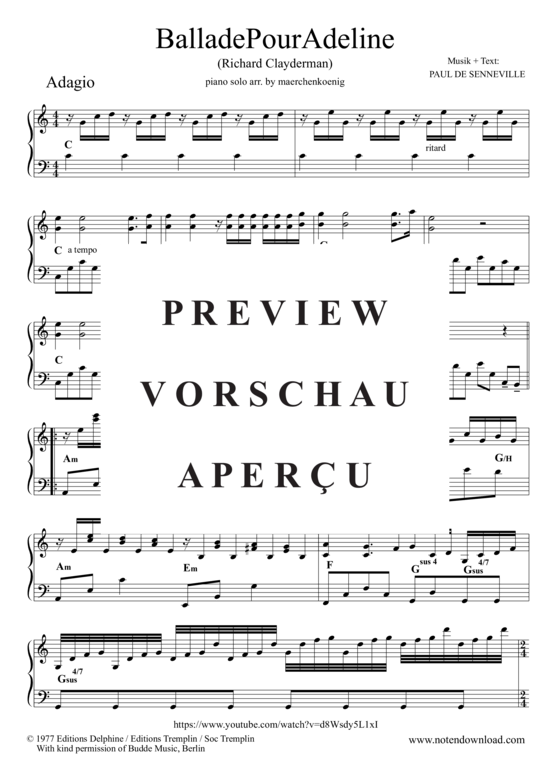
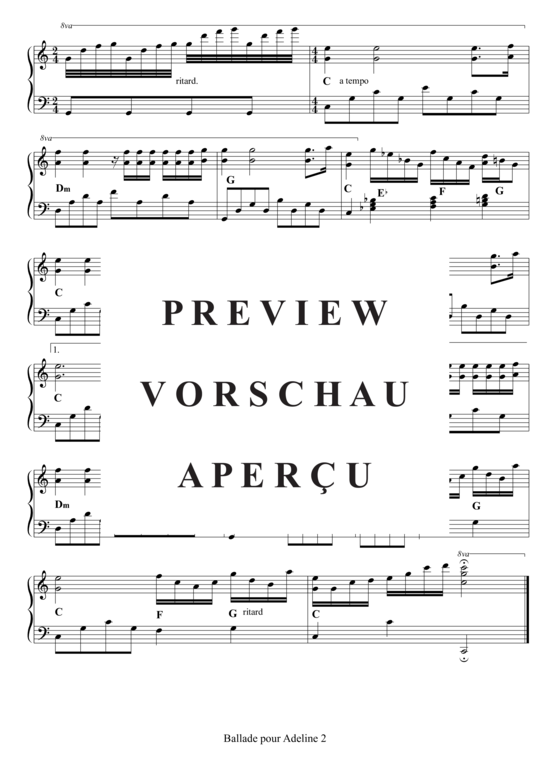
„Ballade Pour Adeline" ranks among the most frequently performed pieces in easy-listening piano literature — and these sheet music arrangements make it clear why the piece has accompanied generations of pianists. The arrangement is aimed at players with a solid intermediate level: the wide melodic range from C4 to G6 and the characteristic interval leaps demand genuine control and deliberate fingering technique.
Piano Sheet Music „Ballade Pour Adeline" – a timeless ballad for solo piano
Paul de Senneville wrote this piece in 1976 as a personal homage. Richard Clayderman brought it to worldwide fame. His playing style combines classical elegance with accessible melody — not virtuosity for its own sake, but expression through clarity and simplicity of touch.
The key of C major — no accidentals, immediately approachable — gives the piece its open, bright sound. The 4/4 time signature creates a gently rocking pulse at 60 BPM that carries the melody without rushing it. The playing time is approximately 2:02 minutes. Formally, the piece follows a three-part structure with reprise (A–B–A): a singable main theme, a contrasting middle section, and the return of the opening theme give the piece its satisfying arc — compact in form, yet rich in detail.
The melody spans a range of C4 to G6 (31 semitones, just over 2.5 octaves). The consistently diatonic harmony — all notes remain within the home key, with no chromatic surprises — provides a clear sense of orientation. The left hand carries a characteristic broken-chord accompaniment pattern that is essential to the piece's flowing character. No legato slurs are notated in the score; the articulation is accordingly non-legato to slightly portato — each note speaks cleanly without blending into the next. This gives the melody its characteristic, pearl-like transparency and serves as an important interpretive cue: phrasing here is shaped through dynamics and weight, not through tied slurs.
In terms of technique, the wide interval leaps in the melody line demand particular attention. For upward jumps of a sixth or downward leaps of an octave, anticipatory fingering is strongly recommended: position the thumb over the next target note early, and prepare the hand position during the preceding note — not at the moment of the leap itself. Practising these transitions in isolation at a slow tempo first will develop the accuracy needed without creating tension.

- Range: C4–G6 (31 semitones, approx. 2.5 octaves)
- Main challenges: wide interval leaps, non-legato articulation, dynamic shaping
- Tempo: calm and flowing (60 BPM), playing time approx. 2:02 min
Playing through the wide interval leaps in the right hand alone first — at half tempo, with consciously anticipatory fingering — will quickly reveal where the hand position still hesitates. Those are exactly the spots worth isolating in short segments, rather than always restarting from the beginning. Since no legato slurs are notated, the responsibility for phrasing rests entirely with dynamics: the crescendo toward the climax of the A section and the pulling back into the reprise are not ornamental — they are the structural backbone of the piece. Playing these contrasts flat means losing the emotional arc entirely. The left hand maintains its broken-chord pattern with consistent evenness — players who want to internalise this pulse first can tap it with their foot while the right hand runs through the melody. For longer sustained melody notes, half-pedalling is recommended: it keeps the tone ringing without blurring the left-hand accompaniment figure.
A short demo audio preview is available — ideal for gauging the tempo and character before purchase. The sheet music is available for immediate download after purchase. 100% licensed — ready to perform legally, right away.
Editorially reviewed by the notendownload.com team

Product Reviews