
 Orders
 Addresses
 Payment methods



Details
| Product number: | smd-47486 |
|---|---|
| Instruments: | Guitar |
| Genre: | Pop Music |
| Pop Music: | Popmusik |
| Difficulty: | Medium |
| Experience: | Elementary (3–4 years) |
| Key: | E Major |
| Language: | English |
| Artist: | Robbie Williams |
| Authors: | Chambers, Guy |
| Pages: | 2 |
| duration: | 03:56 |
| Publisher: | Hal Leonard |

Angels - Sheet Music for Guitar Chords/Lyrics Robbie Williams








 100% Legal & Licensed
 Verified by Musicians
 No Subscription. One-Time Purchase.
 Instant Download after Purchase
Details
| Product number: | smd-47486 |
|---|---|
| Instruments: | Guitar |
| Genre: | Pop Music |
| Pop Music: | Popmusik |
| Difficulty: | Medium |
| Experience: | Elementary (3–4 years) |
| Key: | E Major |
| Language: | English |
| Artist: | Robbie Williams |
| Authors: | Chambers, Guy |
| Pages: | 2 |
| duration: | 03:56 |
| Publisher: | Hal Leonard |
Product Description
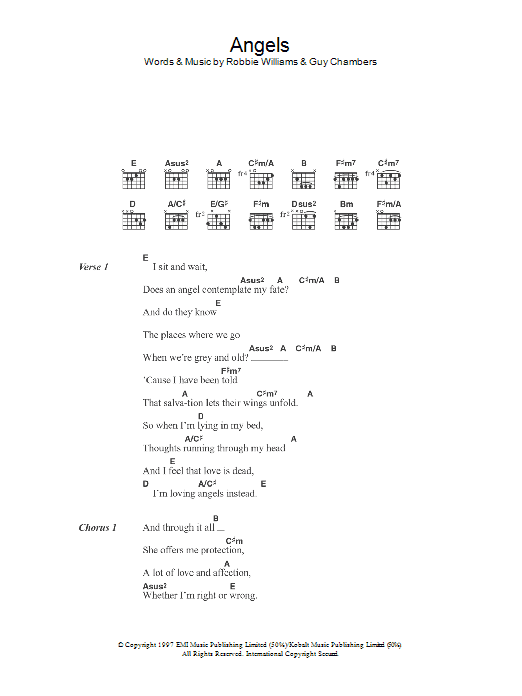
Anyone looking to accompany "Angels" by Robbie Williams around a campfire, in the rehearsal room, or at home will find the right lead sheet here. It contains the complete lyrics with chord symbols, making the calm, stately character of this song immediately accessible.
"Angels" with Chords – Lyrics and Chords for Guitar, Piano, and Voice
"Angels" is one of the best-known ballads in British pop music. Robbie Williams wrote the song together with Guy Chambers; it was released in 1997 on his debut album "Life Thru a Lens" and went on to become an international chart success. With its sweeping, emotionally charged melody and straightforward chord accompaniment, it has established itself equally in concerts, schools, and church services — a piece that singers of all experience levels keep coming back to.
The sheet is in E major and features 15 different chords, including several barre chords as well as extended chords such as F#m7, C#m7, A/C#, and E/G#. Chord diagrams are included. Harmonically noteworthy are the slash chords A/C# and E/G#: their descending bass notes create a chromatic line that gives the song its characteristic depth. The structure follows two verses and three choruses. The difficulty level is intermediate — the barre chords are the deciding factor, particularly C#m/A, B, and F#m7, which need to ring out cleanly.
- Main challenge: Barre chords C#m/A, B
Practice the barre chords C#m/A, B, and F#m7 in isolation first — switch between them slowly until each shape is secure before adding the rhythm. Two common issues to watch for: with barre chords, the index finger often fails to press evenly across all strings, leaving individual notes muted — placing the finger as close to the fret as possible and consciously shifting pressure toward the higher strings helps considerably. With F#m7 and C#m7, neighboring strings tend to get unintentionally dampened when the fretting fingers aren't angled steeply enough; plucking each string individually after forming the chord is a reliable way to identify problem spots. Typical stumbling points within the song itself are the change from B to C#m/A in the chorus and the quick transition from A/C# to E/G# in the verse — it's well worth looping exactly these transitions in practice. For the strumming pattern: in 4/4 time, a pattern with an accented downstroke on beats 1 and 3, a muted downstroke on beat 2, and a light upstroke on the "and" of beat 4 works very well — it gives the song its quietly forward-moving flow without overloading the ballad structure. A gentle fingerpicking pattern also suits the song's stately character beautifully. If the key doesn't sit comfortably in your vocal range, a capo on the 2nd or 4th fret will shift things into a more manageable position.
A score preview is not available for this title. The lead sheet is available immediately as a PDF download after purchase — 100% licensed.
Editorially reviewed by the notendownload.com team