

 Orders
 Addresses
 Payment methods




Details
| Product number: | NSF4MC7 pdf |
|---|---|
| Arrangement: | Instrumentation with vocals |
| Instruments: | Choir |
| Genre: | Romantic |
| Era: | 19th Century |
| Choir: | Men's choir |
| Difficulty: | Easy |
| Key: | F Major |
| Language: | German |
| Tempo: | 92 |
| Authors: | Silcher , Friedrich (1789-1860) |
| Pages: | 2 |
| duration: | 02:18 |
| Publisher: | Notensatz S. Fischer |
Ännchen von Tharau - Sheet Music for male choir Friedrich Silcher (1789-1860)








 100% Legal & Licensed
 Verified by Musicians
 No Subscription. One-Time Purchase.
 Instant Download after Purchase
Details
| Product number: | NSF4MC7 pdf |
|---|---|
| Arrangement: | Instrumentation with vocals |
| Instruments: | Choir |
| Genre: | Romantic |
| Era: | 19th Century |
| Choir: | Men's choir |
| Difficulty: | Easy |
| Key: | F Major |
| Language: | German |
| Tempo: | 92 |
| Authors: | Silcher , Friedrich (1789-1860) |
| Pages: | 2 |
| duration: | 02:18 |
| Publisher: | Notensatz S. Fischer |
Product Description
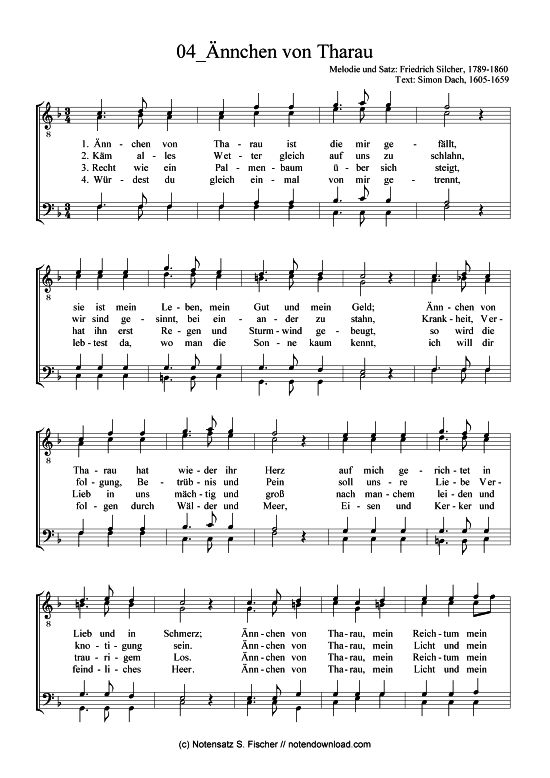
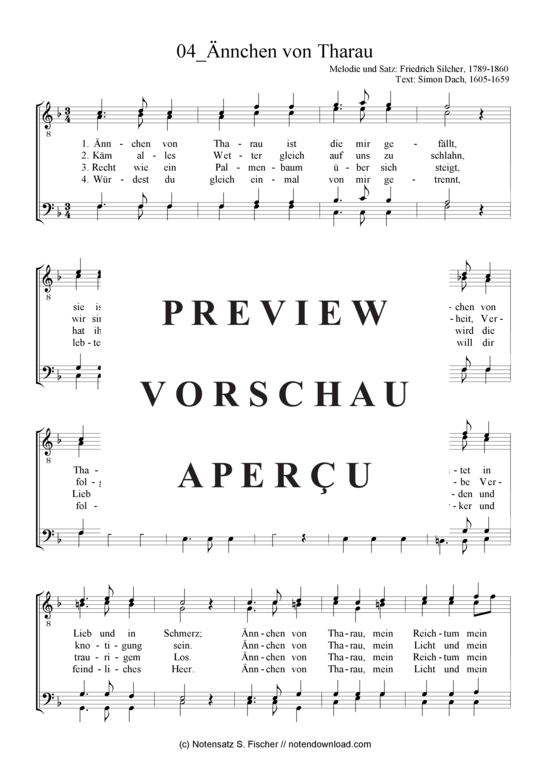
"Ännchen von Tharau" belongs to the core repertoire of the German male choir tradition — and this edition makes it easy to get started. The homophonic choral setting is characterized by all voices moving largely in rhythmic unison, which means ensembles with as little as about one year of shared choral experience can approach it with confidence.
Sheet Music "Ännchen von Tharau" – Lyrical Romanticism for Male Choir
Friedrich Silcher (1789–1860) served as Music Director at the University of Tübingen and was a defining figure in the German male choir repertoire of the 19th century. His work falls within the Romantic era — a period in which the folk song was consciously cultivated as an expression of national identity and emotional intimacy. "Ännchen von Tharau" draws on an older poem celebrating loyalty and devotion, a theme that has kept the piece firmly rooted in popular tradition to this day. Silcher shaped this message into a simple, memorable melody that feels tailor-made for male voices.
The arrangement is set in F major and moves harmonically within a largely diatonic framework — a few chromatic tones add color without departing from the clear tonality. The 3/4 time signature gives the piece its song-like, gently flowing character. The tenors carry the melody in the middle to upper register, a range that demands carrying power. The basses provide the harmonic foundation in the lower register and need projection there to support the ensemble's overall sound. At approximately 47 seconds and 24 bars, the piece is compact in form and clear in structure.
- Ideal for: Choir rehearsals, club evenings, folk music concerts
- Tempo: Gently flowing
- Main challenge: 1st Tenor reaching up to high B♭, dynamic control in piano — pulling back together as an ensemble
 |  |
 |  |
Bass singers who consciously engage breath support — that is, an active airflow — from the very first note in the lower register will quickly notice how much carrying power this adds to the ensemble's overall sound. It is well worth working through the bass parts separately in early rehearsals before combining them with the tenors: this allows the basses to develop confidence in their projection without leaning on the melody for orientation. The homophonic texture makes the subsequent blending straightforward — all voices move in rhythmic unison and the pulse is clear. The dynamic contrasts that run throughout the piece call for genuine ensemble discipline: learning to pull back together in piano is an art in itself, and one that rewards the effort.
A short demo audio preview is available so you can get a feel for the character of the piece before purchasing. The sheet music is available for immediate download after purchase. 100% licensed — ready to perform, legally, right away.
Editorially reviewed by the notendownload.com team
