

 Orders
 Addresses
 Payment methods



Details
| Product number: | PBK104 pdf |
|---|---|
| Arrangement: | Solo |
| Instruments: | Double Bass |
| Genre: | Classical |
| Era: | Contemporary |
| Authors: | Verster , Alexander |
| Pages: | 12 |
| Publisher: | PRObass Musikverlag |
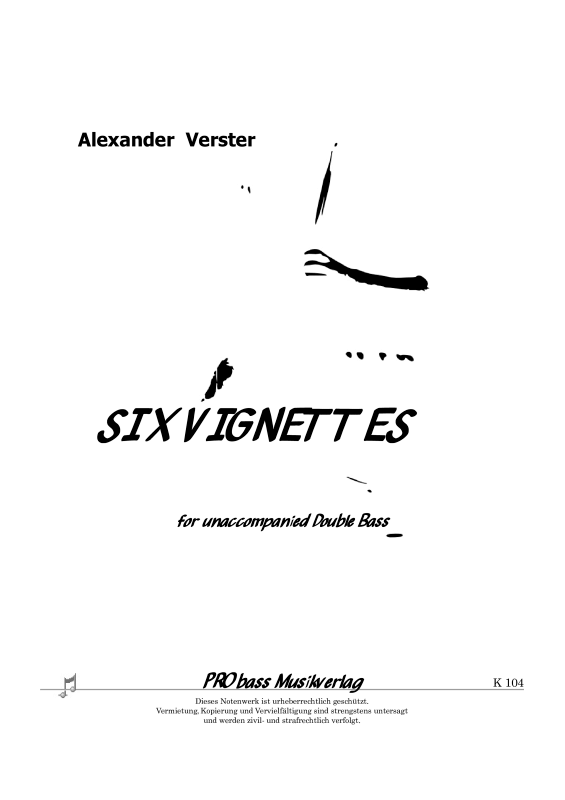
Six Vignettes for unaccomanied Double Bass - Sheet Music for Double Bass Solo Alexander Verster








 100% Legal & Licensed
 Verified by Musicians
 No Subscription. One-Time Purchase.
 Instant Download after Purchase
Details
| Product number: | PBK104 pdf |
|---|---|
| Arrangement: | Solo |
| Instruments: | Double Bass |
| Genre: | Classical |
| Era: | Contemporary |
| Authors: | Verster , Alexander |
| Pages: | 12 |
| Publisher: | PRObass Musikverlag |
Product Description
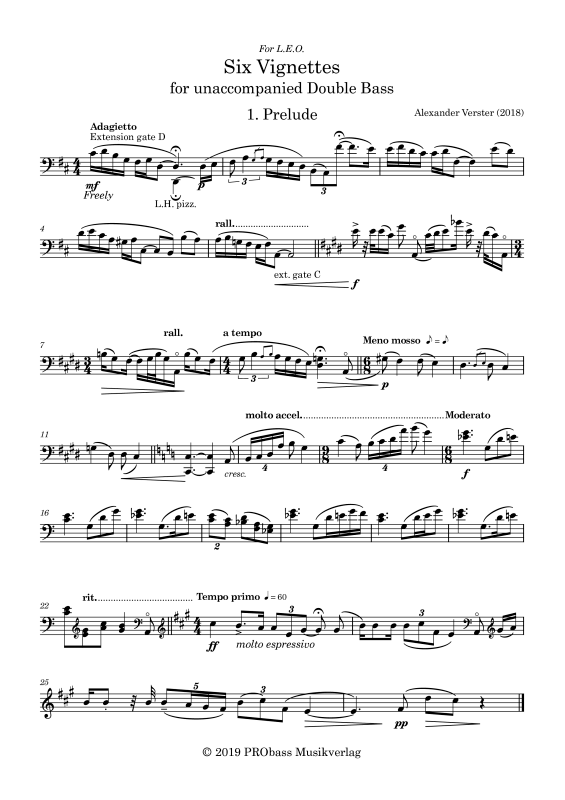
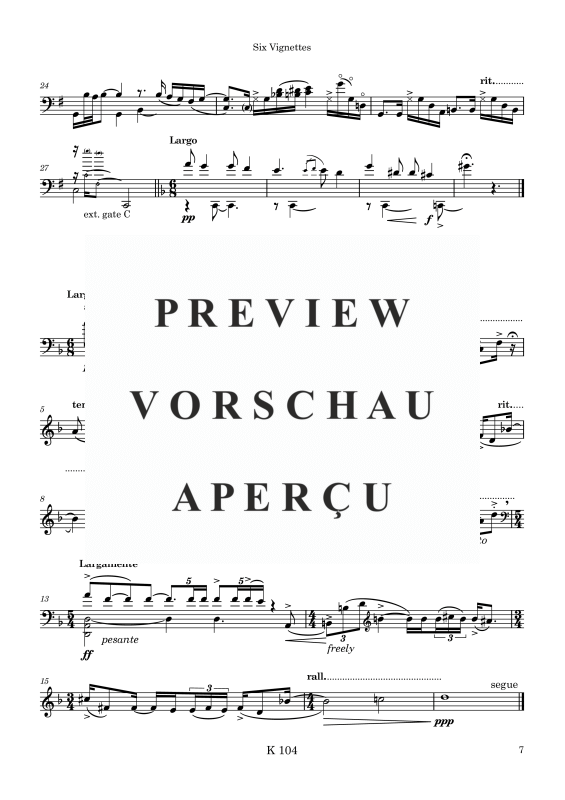
The origins of Six Vignettes are somewhat unusual: about half of the melodic ideas come from a series of recorded voice messages. These were very loosely transcribed and shaped into tonal melodies and coherent rhythms, resulting in a variety of different characters that the composer envisions as a series of "vignettes" (badges).
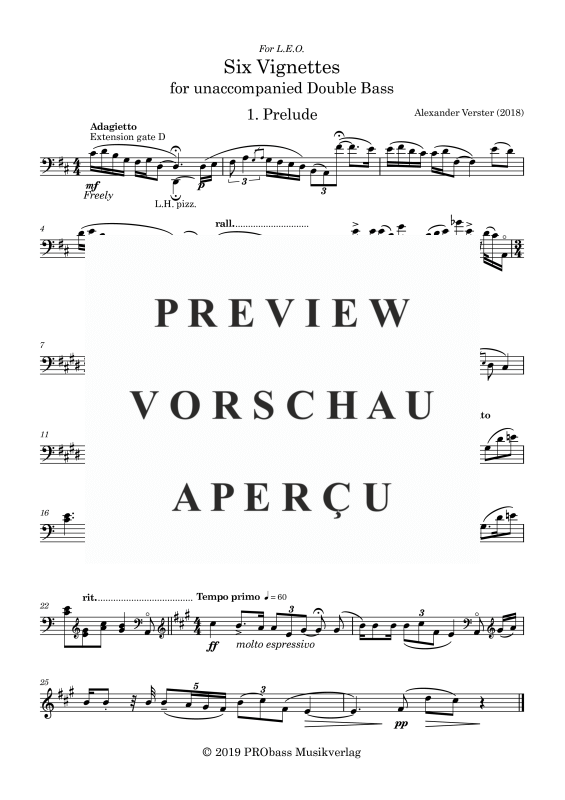
1. Prelude: The Prelude introduces most of the thematic material used throughout the suite and gives a stylistic indication of what to expect from the work.
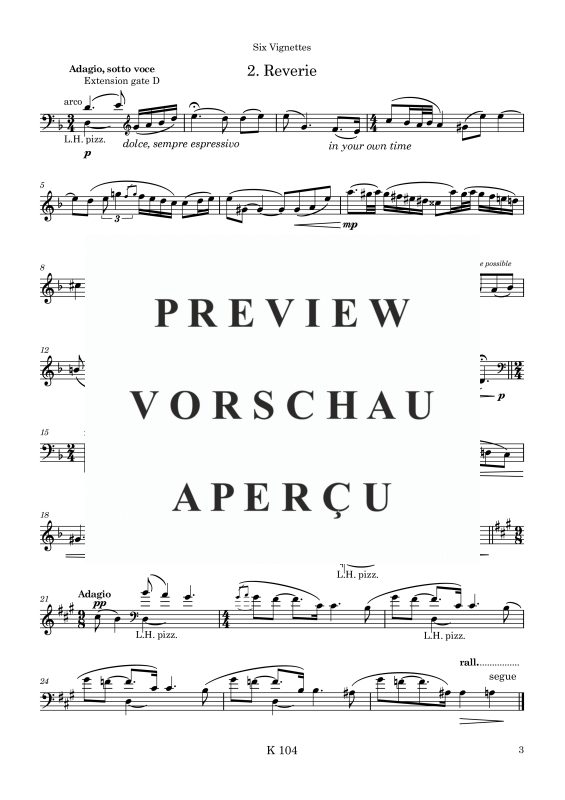
2. Reverie (Träumerei) A short, dreamlike piece that also serves as a seamless introduction to the Dirge. These two movements can be used in isolation to serve as a pair of contrasting pieces that cover most of the instrument's range.
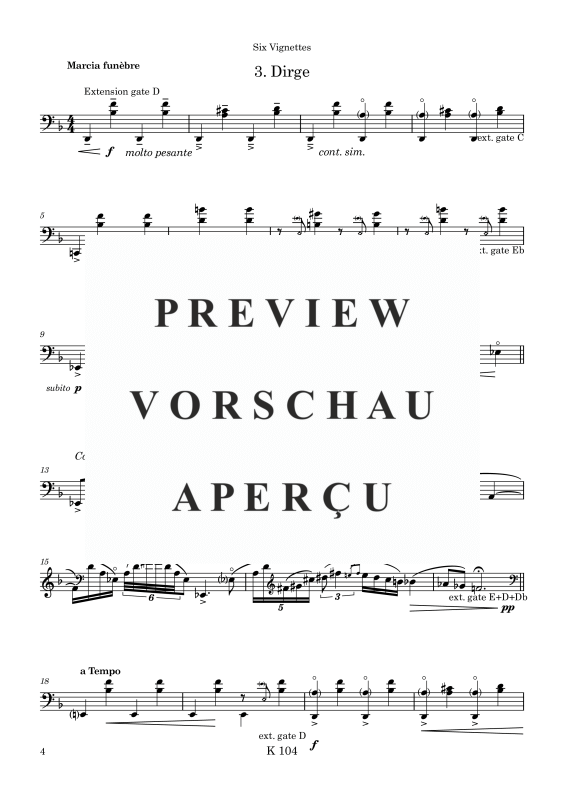
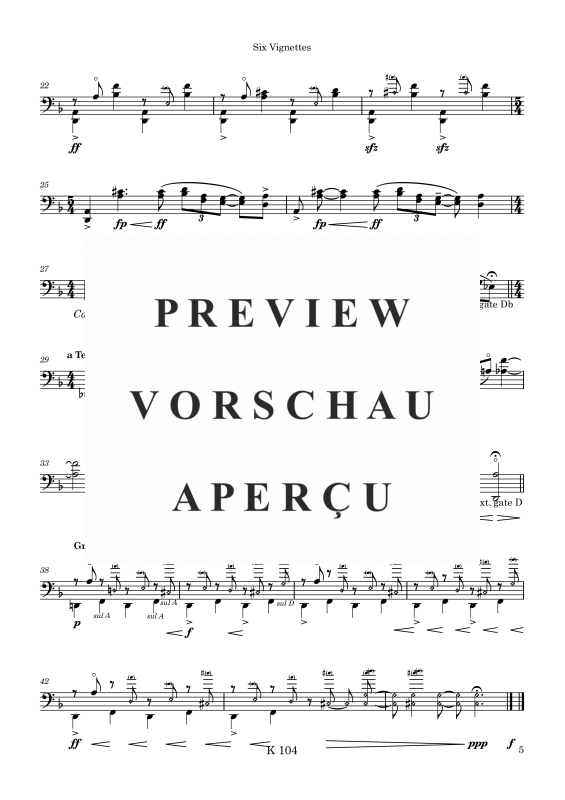
3. Dirge (Funeral Song) A dark and heavy piece of music that takes full advantage of the special character and sound of the double bass. Other performance solutions can be worked out by players without gate C extension, but this requires even more shifting and impairs the open string resonance.
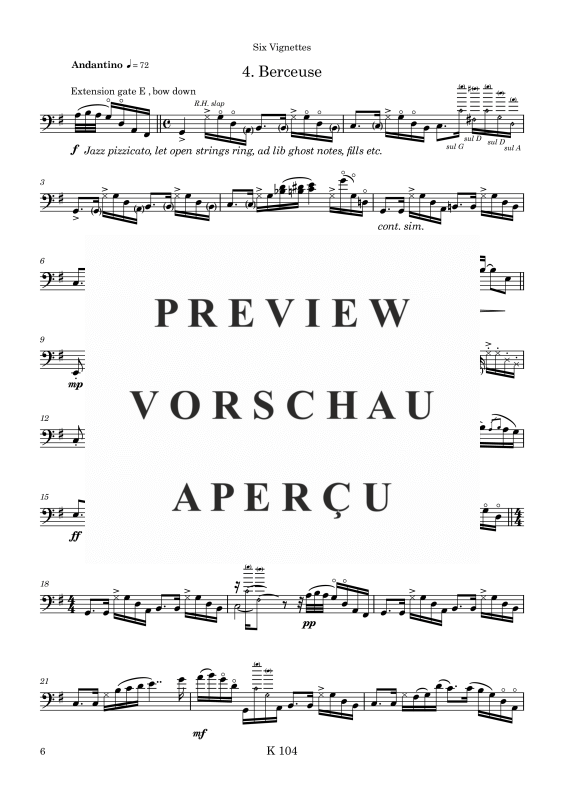
4. Berceuse A jazz lullaby played entirely in pizzicato. Somewhat naive in its harmonic simplicity, but with slight relaxation after the dirge, as well as stylistic variation within the suite as a whole. This movement was originally an improvisation based on the main pattern, ad lib is therefore recommended!
5th Lament A return to the style and (melo)drama of the previous movements. The temporarily sombre mood is lightened and resolved by an uplifting interlude.
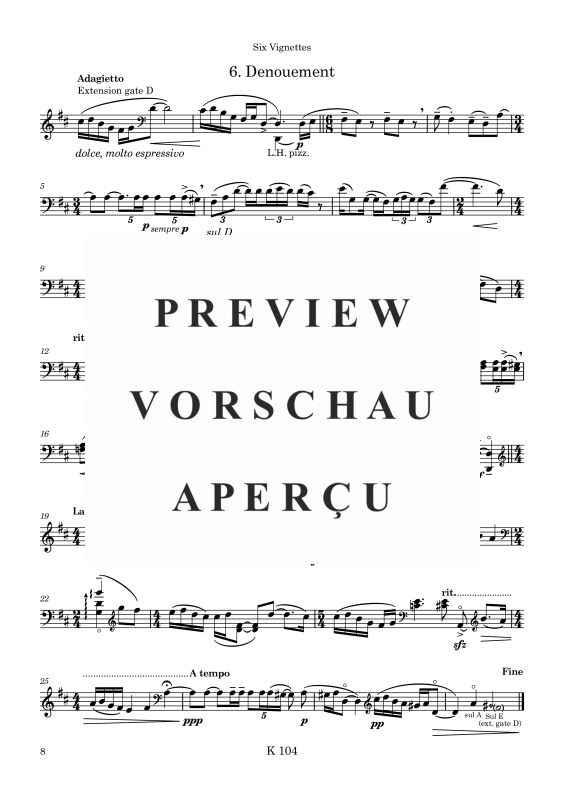
6. Denoument (Resolution) Although there is no deliberate narrative thread linking the 'Six Vignettes', a sense of storytelling is inevitable in any work consisting of several contrasting movements. This movement leads the suite to its denouement, and the 'plot' to its conclusion ... The piece is written for 4-string double bass with extension mechanism (C machine).