

 Orders
 Addresses
 Payment methods



Details
| Product number: | fbd-56288 |
|---|---|
| Arrangement: | Quartet |
| Instruments: | Cello , Viola , Violin |
| Genre: | Classical |
| Classical: | Classical 21th Century , Classical in general , Concert piece , Contemporary |
| Quartet: | String Quartet |
| Artist: | Richard Dubugnon |
| Authors: | Richard Dubugnon |
| Pages: | 89 |
| Publisher: | Birdsong |
Säkulare Suite - Sheet Music for Richard Dubugnon








 100% Legal & Licensed
 Verified by Musicians
 No Subscription. One-Time Purchase.
 Instant Download after Purchase
Details
| Product number: | fbd-56288 |
|---|---|
| Arrangement: | Quartet |
| Instruments: | Cello , Viola , Violin |
| Genre: | Classical |
| Classical: | Classical 21th Century , Classical in general , Concert piece , Contemporary |
| Quartet: | String Quartet |
| Artist: | Richard Dubugnon |
| Authors: | Richard Dubugnon |
| Pages: | 89 |
| Publisher: | Birdsong |
Product Description
Säkulare Suite for String Quartet by Richard Dubugnon, after the works of J.S. Bach.
Commissioned by the Swiss Chamber Concerts. The first performance took place in 2016 at St Peter's Church, Zürich, by the Winterthurer Streichquartett.
Duration: 20 minutes
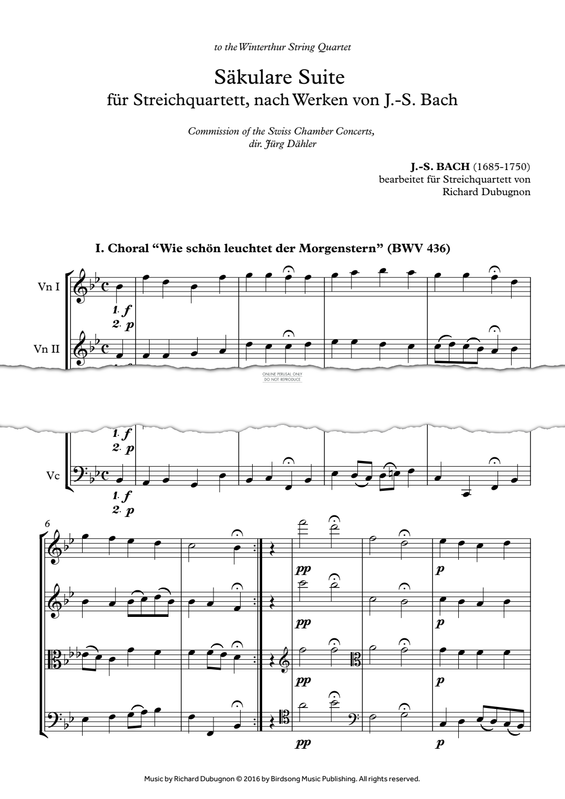
- Choral “Wie schön leuchtet der Morgenstern” (BWV 436) (La lumière du matin brille si joliment). - Matin
- Sinfonia “Gleich wie der Regen und Schnee vom Himmel fällt” (Cantate BWV 18) (La pluie et la neige tombent du ciel).
- Recitativo : Alto solo (BWV 18) (sur le même texte).
- Arie “Schafe können sicher weiden” (Cantate BWV 208) (Les moutons peuvent paître en sécurité). Alto solo.
- “An Wasserflüssen Babylon” (original pour orgue BWV 653) (Par les fleuves de Babylone).
- Choral “Christe, der du bist Tag und Licht” (BWV 274) (Christ, toi qui es jour et lumière). - Midi
- Præludium (original pour clavier, BWV 898)
- Fuga, “B. A. C. H.” (original pour clavier, BWV 898).
- Choral “Die Nacht ist kommen” (BWV 296) - (La nuit est venue). - Nuit
Programme Notes (ENG):
The string quartet did not exist at the time of Bach as a separate musical formation. For this reason, this sequel looks like an anachronism, even a paradox. I wanted to do here a little more than a simple transcription of Bach’s works and I chose nine different pieces, all related to the theme of nature. The pieces come from cantatas and chorales as well as instrumental works and are also presented in a thematic arch that follows a quasi-esoteric thread representing the journey of a day, from morning to noon and until night. The music of the Leipzig Kantor is almost unchanged, apart from small passage notes in some chorales, ornaments and modifications of octaves to make the music more suited to the virtuoso playing of the string quartet. Anxious to make colors, I opted for the use of mutes in no IV to evoke recorders. The viola replaces the voice in this piece that has remained famous for its many adaptations, especially for solo piano.
No V is the nerve centre of this suite, a chorale originally for organ, with the viola (again as a soloist) playing the chorale, emulating a reed stop. The chorale VI has a Renaissance colour, because it is played in slightly arpeggiated pizzicati to evoke the lute and the theorbo.
No VII is a small French overture for keyboard written by a young J.S. Bach (although there is still some speculation about the paternity of this work). In the fugue that follows, I took the liberty of adding to the end a characteristic recapitulation on a tonic pedal, which I felt was missing. This fugue’s key is magically linked with the final “Die Nacht ist kommen” chorale in Bb major, whose 3 fermatas (or pauses) between the last periods lengthen more and more, as a progressive entry into the night.
© Richard Dubugnon, Paris 2023