

 Orders
 Addresses
 Payment methods



Details
| Product number: | mfgt079b pdf |
|---|---|
| Arrangement: | Orchestra |
| Genre: | Classical music in general |
| Tempo: | Moderato |
| Authors: | Tailleferre, Germaine (1906-1983) |
| Pages: | 57 |
| duration: | 16:00 |
| Publisher: | Musik Fabrik Music Publishing |
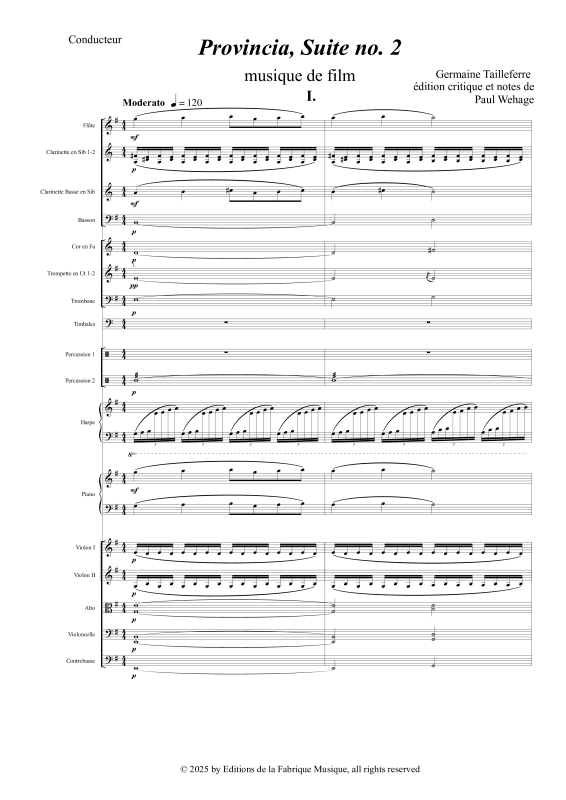
Provincia Suite no. 2 - Sheet Music for Orchestra Germaine Tailleferre








 100% Legal & Licensed
 Verified by Musicians
 No Subscription. One-Time Purchase.
 Instant Download after Purchase
Details
| Product number: | mfgt079b pdf |
|---|---|
| Arrangement: | Orchestra |
| Genre: | Classical music in general |
| Tempo: | Moderato |
| Authors: | Tailleferre, Germaine (1906-1983) |
| Pages: | 57 |
| duration: | 16:00 |
| Publisher: | Musik Fabrik Music Publishing |
Product Description
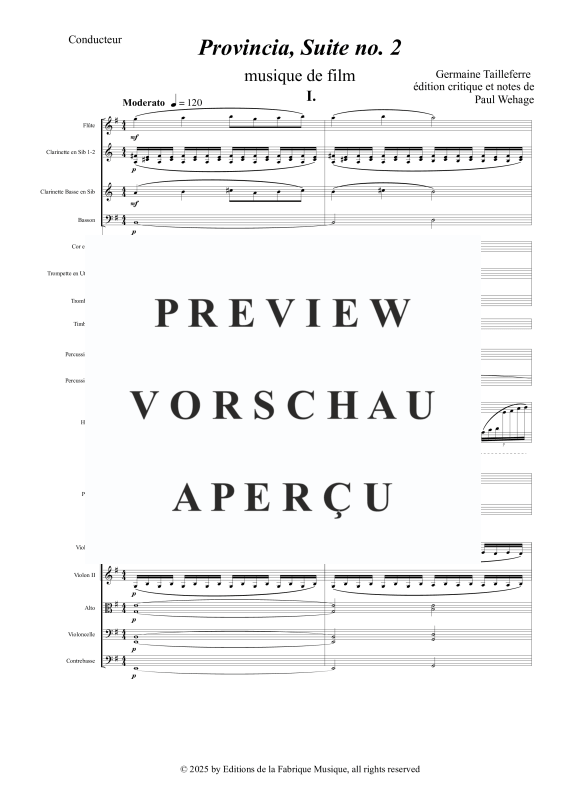
Maurice Cloches documentary film "Provincia" (1935), distributed through the Comptoir Français du Film Documentaire, dealt with the Roman antiquities of southern France – the Provincia Romana, which gave the region its modern name. Germaine Tailleferres's music, here arranged as two independent concert suites, translates this theme into a carefully organized musical schema that alternates between three different registers: an evocation of the public spectacle of antiquity, an evocation of its sacred and architectural repose, and a purely orchestral register connected with landscape and the present.
The voiceless choral passages
Alongside the Latin declamation, the choir appears in two further, text-free passages: a hymn in 5/4 time and a bacchanal finale in 5/8 time, both set for vocalize (wordless choral melody) and orchestra. While the Latin cento is concrete and historically specific, these two movements function through atmosphere and irregular meter alone – a register of ritualistic suggestion rather than reconstruction. Throughout the score, a consistent principle applies: every sung passage is set in an irregular meter (5/8, 5/4, or the freely declaimed Latin), while the purely orchestral passages are confined to simple meters (3/4, 4/4). Voice and metric irregularity are reserved throughout for the evocation of the ancient world; regular meter and orchestra alone carry the descriptive, present-oriented material.
The choir in the Bacchanal: a performance issue, not a compositional one
The choral part in the 5/8-time Bacchanal finale is crossed through in the manuscript but remains intact and legible – evidence of a cut made in the production phase and not a reworking of the music itself. A directly comparable case is preserved in Tailleferres's music for "Sur les Routes d'Acier" (1938), where the choir was actually recorded, but the passage – also set in irregular 5/8 time – proved unmanageable for the ensemble assembled for the recording session and was replaced with spoken text over the orchestra in the published version. The difficulty in this case is well known: an irregular meter sung against an independent orchestral pulse presents a challenging coordination problem for any choir without extensive rehearsal, and Tailleferres's harmony – centered on C but densely filled with major and minor seconds and sevenths – offers little tonal support to regain pitch if the ensemble falls out of time. Given the identical metric problem (5/8) in the Provincia Bacchanal, the same practical cause is the most likely explanation for its cut, not a deficiency in the vocal composition. This edition therefore restores the choral part as primary text, with the historical cut noted for the performer's information: the passage is fully performable by a modern choir with sufficient rehearsal time to secure pitch against the asymmetrical meter, and should be omitted only as a fallback consistent with 1930s production practice, not as Tailleferres's preferred version.