

 Orders
 Addresses
 Payment methods



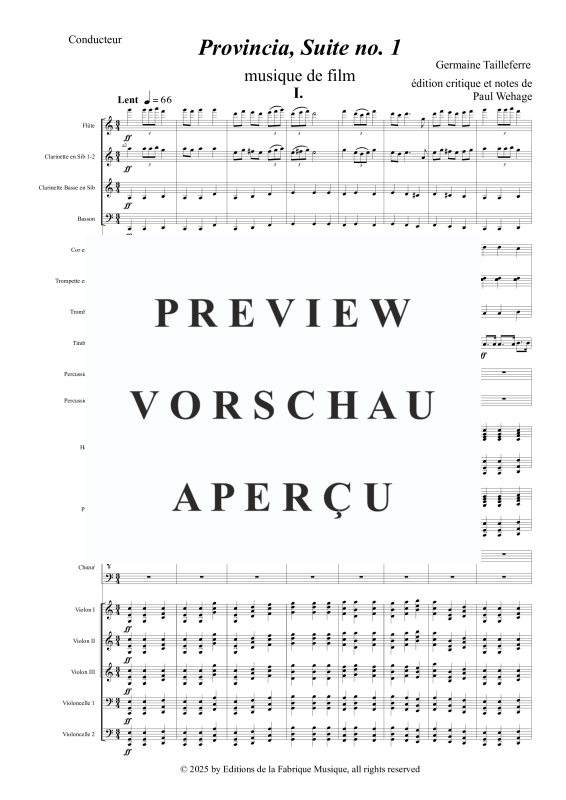
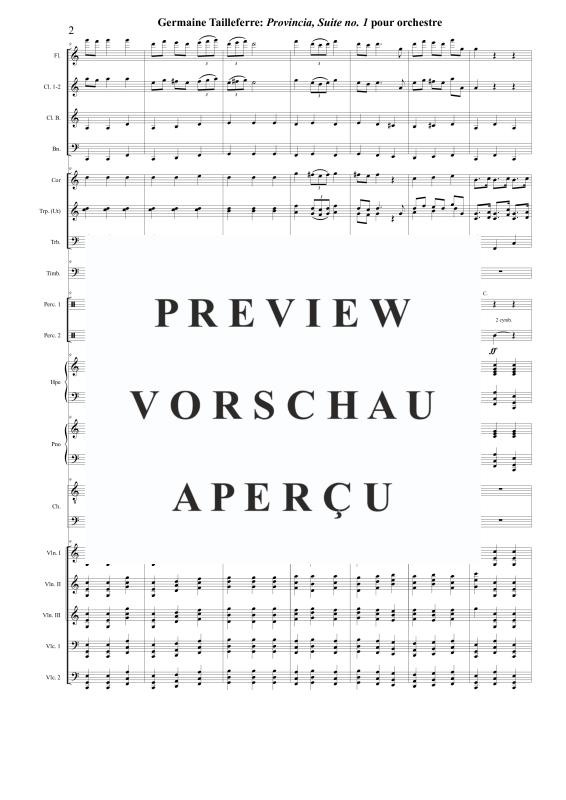
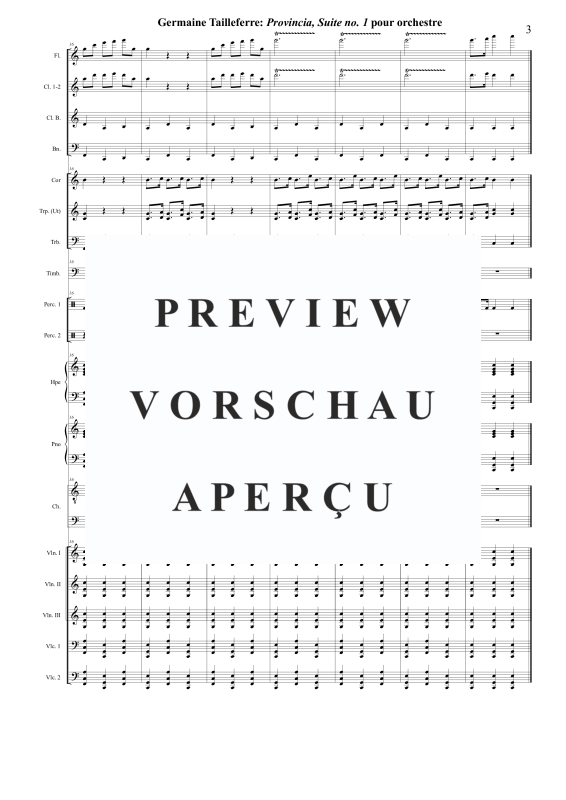
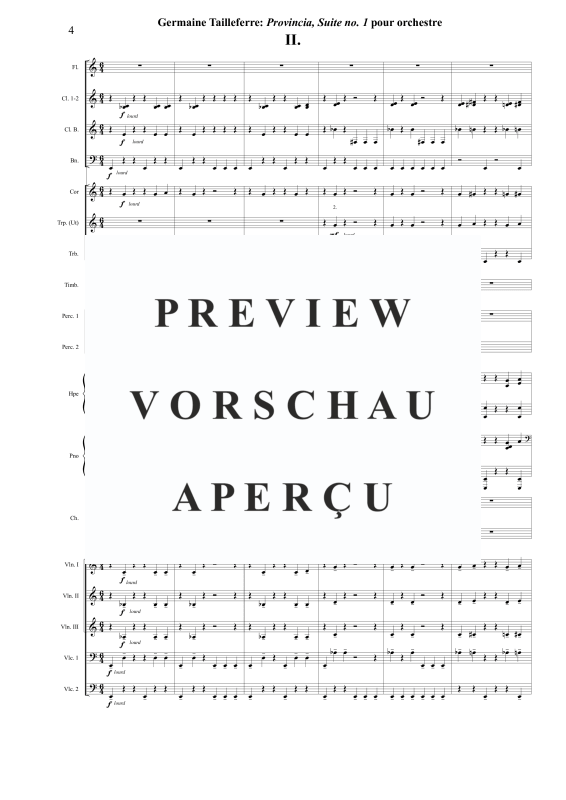
Details
| Product number: | mfgt079a pdf |
|---|---|
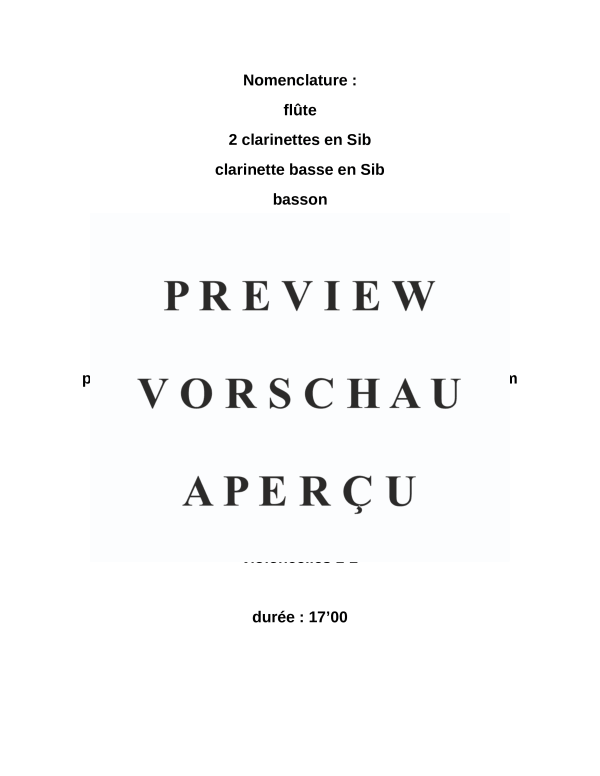
| Arrangement: | Orchestra |
| Genre: | Concert work |
| Authors: | Tailleferre, Germaine (1892-1983) |
| Pages: | 47 |
| duration: | 17:00 |
| Publisher: | Musik Fabrik Music Publishing |
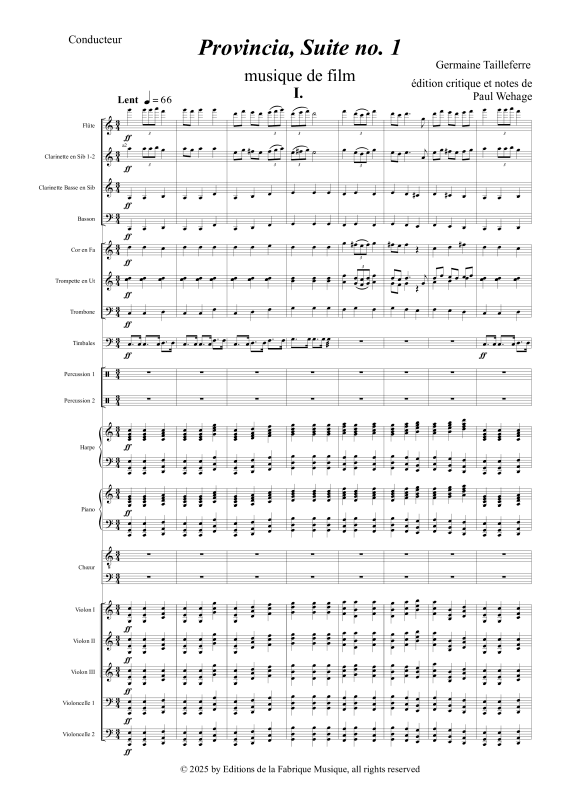
Provincia - Suite no. 1 - Sheet Music for Orchestra Germaine Tailleferre








 100% Legal & Licensed
 Verified by Musicians
 No Subscription. One-Time Purchase.
 Instant Download after Purchase
Details
| Product number: | mfgt079a pdf |
|---|---|
| Arrangement: | Orchestra |
| Genre: | Concert work |
| Authors: | Tailleferre, Germaine (1892-1983) |
| Pages: | 47 |
| duration: | 17:00 |
| Publisher: | Musik Fabrik Music Publishing |
Product Description
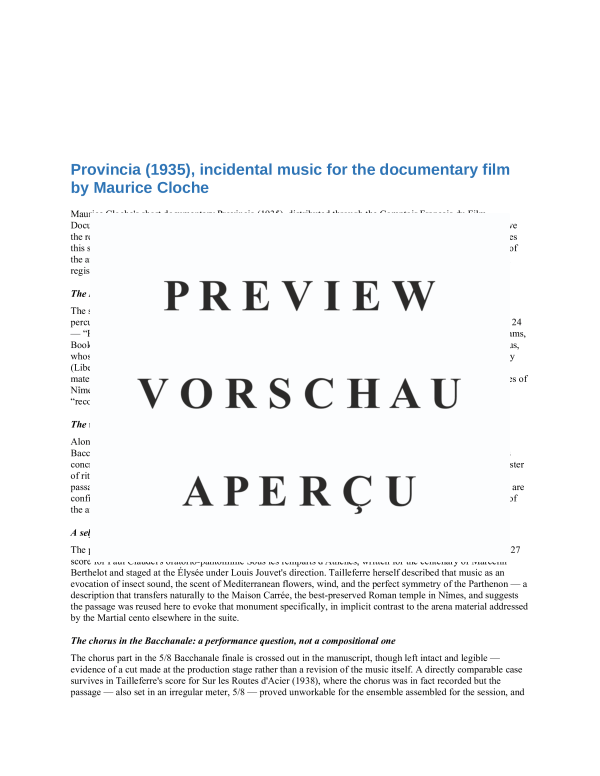
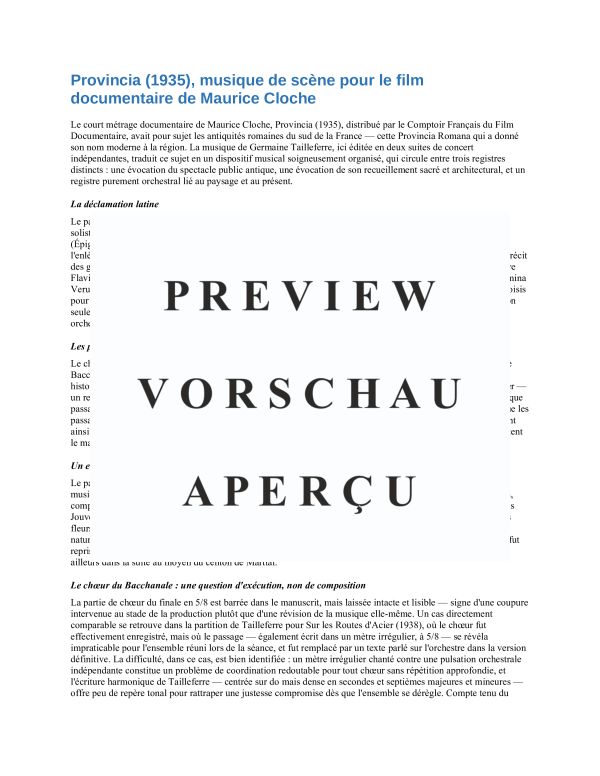
Maurice Cloches's brief documentary film "Provincia" (1935), distributed through the "Comptoir Français du Film Documentaire", focused on the Roman antiquities of Southern France – the "Provincia Romana", which gave the region its present-day name. Germaine Tailleferre's score, here arranged into two independent concert suites, translates this theme into a carefully conceived musical concept that moves between three distinct levels: an evocation of the public spectacles of antiquity, an evocation of its sacred and architectural silence, and a purely orchestral level connected to landscape and the present.
The Latin Declamation
The most impressive passage in the score is a cento of three epigrams by Martial for solo voice, male chorus, and percussion instruments exclusively, without any other instruments: the famous portrait of the gladiator Hermes (Epigrams, Book V, 24 — "Hermes Martia saeculi voluptas..."), the dialogue with Jupiter's eagle about the abduction of Ganymede (Epigrams, Book V, 55 – "Dic mihi, quem portas, volucrum regina?...") and the depiction of the gladiators Priscus and Verus, whose evenly matched combat at the opening games of the Flavian Amphitheatre ended in a rare double victory (Liber de Spectaculis, 29 – "Cum traheret Priscus, traheret certamina Verus..."). All three texts come from the context of Roman arena spectacles and were almost certainly chosen to accompany film footage of the amphitheatres at Nîmes or Arles. The reduced instrumentation – voices and percussion instruments exclusively – gives this section a strongly "reconstructed" character that contrasts with the fuller orchestral treatment elsewhere in the score.
The Wordless Choral Passages
Alongside the Latin declamation, the chorus appears in two other, textless passages: a hymn in 5/4 time and a bacchanal-like finale in 5/8 time, both scored for vocalise (wordless chorus) and orchestra. While the Latin cento is concrete and historically specific, these two movements seem to work purely through their atmosphere and their irregular meter – more as ritual suggestion than reconstruction. A uniform principle applies throughout the score: every sung passage is set in an irregular meter (5/8, 5/4, or freely declaimed Latin), while the purely orchestral passages are confined to simple meters (3/4, 4/4). Voice and metric irregularity are consistently reserved for the evocation of the ancient world, while regular meter and orchestra alone carry the descriptive, contemporary material.
A Self-Quotation
The passage that concludes the first suite is not new composition: it comes from the closing sequence of Tailleferre's 1927 score for Paul Claudel's oratorio-pantomime "Sous les remparts d'Athènes", written for the hundredth birthday of Marcelin Berthelot and performed at the Élysée under the direction of Louis Jouvet. Tailleferre herself described this music as an evocation of insect sounds, the scent of Mediterranean flowers, the wind and the perfect symmetry of the Parthenon – a description that transfers seamlessly to the Maison Carrée, the best-preserved Roman temple at Nîmes, and suggests that the passage was reused here to specifically evoke this monument, in implicit contrast to the arena material featured elsewhere in the suite in the Martial cento.
The Chorus in the "Bacchanale": a Question of Performance, not Composition
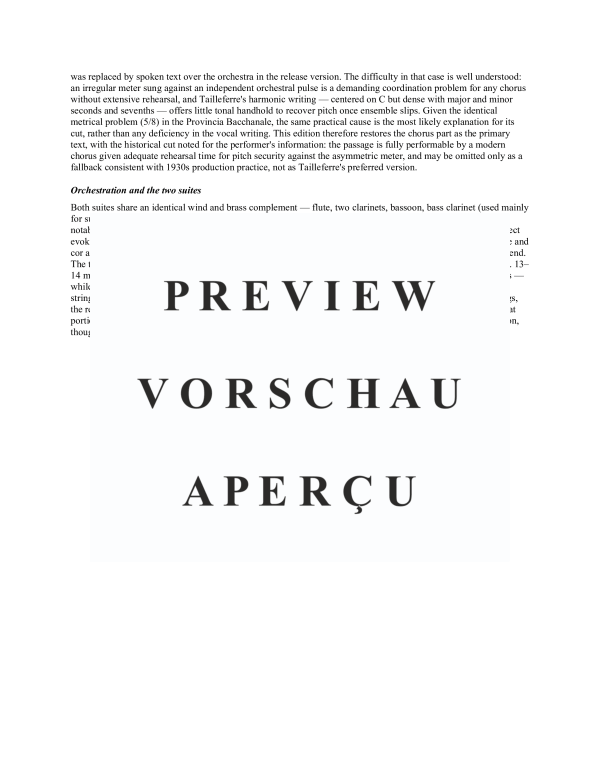
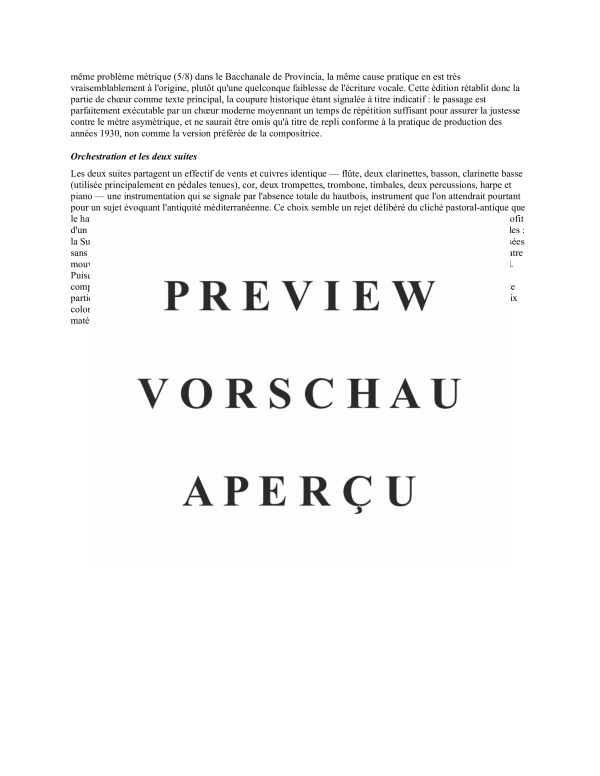
The chorus part in the 5/8 bacchanal finale is struck through in the manuscript, but remained intact and legible – evidence that this was a cut made during the staging phase and not a revision of the music itself. A directly comparable case is found in Tailleferre's score for "Sur les Routes d'Acier" (1938), where the chorus was indeed recorded, but the passage – also in an irregular meter, 5/8 – proved impractical for the ensemble assembled for the recording and was replaced by spoken text over the orchestra in the published version. The difficulty in this case is readily understandable: an irregular meter sung against an independent orchestral pulse presents a challenging coordination problem for any chorus without extensive rehearsal, and Tailleferre's harmonic writing – centred on C but rich in major and minor seconds and sevenths – offers little tonal footing to recover pitch once the ensemble falls out of time. Given the identical metrical problem (5/8) in the "Provincia Bacchanale", the same practical reason is the most likely explanation for its deletion, rather than any fault in the vocal line. This edition therefore restores the chorus part as primary text, with the historical cut noted for the information of performers: the passage is fully performable by a modern chorus with adequate rehearsal time to secure pitch in the asymmetrical meter, and should be omitted only as an expedient solution in accordance with the performance practice of the 1930s, not as Tailleferre's preferred version.