

 Orders
 Addresses
 Payment methods





Details
| Product number: | BDM003KS pdf |
|---|---|
| Arrangement: | Solo |
| Instruments: | Piano |
| Genre: | Romantic |
| Era: | 19th Century |
| Piano: | Piano Easy |
| Difficulty: | Easy |
| Experience: | Beginner (1–2 years) |
| Key: | A Minor |
| Tempo: | 60 |
| Authors: | Grieg , Edward (1843-1907) |
| Pages: | 2 |
| duration: | 01:12 |
| Publisher: | Bernhard Dick |
Morgenstimmung - Sheet Music for Piano solo easy Edvard Grieg








 100% Legal & Licensed
 Verified by Musicians
 No Subscription. One-Time Purchase.
 Instant Download after Purchase
Details
| Product number: | BDM003KS pdf |
|---|---|
| Arrangement: | Solo |
| Instruments: | Piano |
| Genre: | Romantic |
| Era: | 19th Century |
| Piano: | Piano Easy |
| Difficulty: | Easy |
| Experience: | Beginner (1–2 years) |
| Key: | A Minor |
| Tempo: | 60 |
| Authors: | Grieg , Edward (1843-1907) |
| Pages: | 2 |
| duration: | 01:12 |
| Publisher: | Bernhard Dick |
Product Description
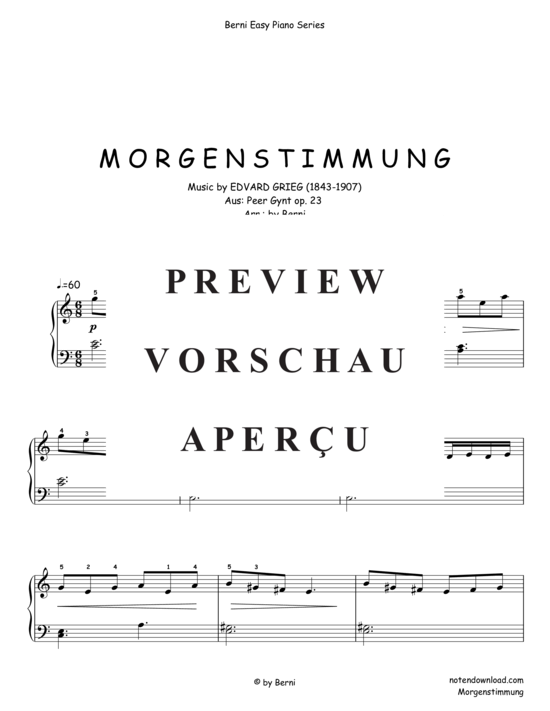
"Morning Mood" is one of the most recognized melodies of the Romantic era — and this piano sheet music makes it accessible to players with approximately two years of lessons. The wide range across both hands demands genuine coordination, though the rhythmic interplay remains approachable thanks to A minor and just one accidental.
Sheet Music "Morning Mood" – Lyrical Romanticism for Solo Piano
Edvard Grieg composed "Morning Mood" as part of his incidental music for Henrik Ibsen's play "Peer Gynt" (op. 23). The melody depicts a desert sunrise — calm, transparent, with an almost impressionistic sense of suspension. Grieg, born in Bergen in 1843, is widely regarded as the most significant Norwegian composer of the 19th century. This edition is drawn from the collection "Peer Gynt op. 23 with Fingerings," offering practical fingering guidance directly within the score.
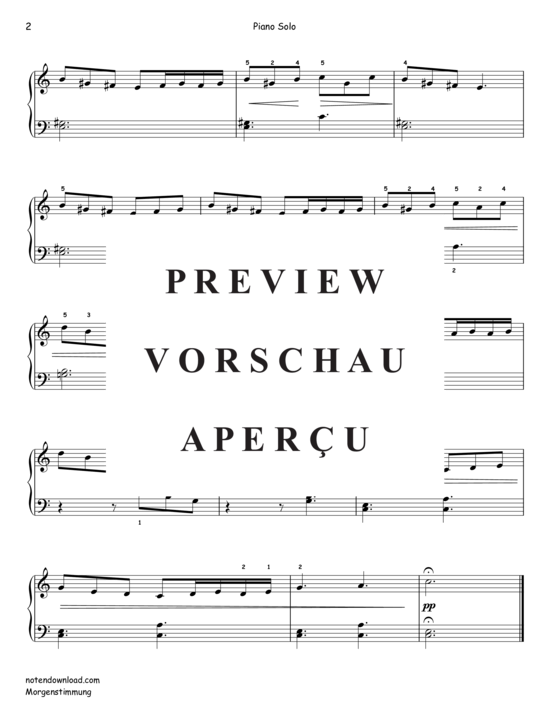
The right-hand melody moves in the upper register, spanning well over two octaves — which requires confident orientation across the keyboard. The writing is entirely diatonic, free of chromatic surprises, making harmonic reading straightforward. The "Easy" classification does come with a caveat, however: the independent rhythmic roles of both hands — the right hand carrying the melody while the left maintains a steady accompaniment pattern — calls for a level of coordination that goes beyond the first year of study.

- Range: c' to a'' (2 octaves)
- Main challenge: independent rhythmic patterns in both hands simultaneously, fast runs in the right hand
- Tempo: 60 — calm and flowing
Practicing the left hand alone first — until the pulse is truly internalized — makes a noticeable difference in how steadily the right hand sits on top. The fast right-hand runs work best when approached note by note, without the left hand, until each note feels secure before combining the two. The range reaches quite high: if the stretch of the melody in the upper register is unfamiliar territory, isolating and drilling the highest passages separately will build confidence quickly.
A short audio preview is available, so you can get a feel for the character of the piece before purchasing. The sheet music is available for immediate download after purchase. 100% licensed — ready to play, legally, right away.
Editorially reviewed by the notendownload.com team