Orders
 Addresses
 Payment methods





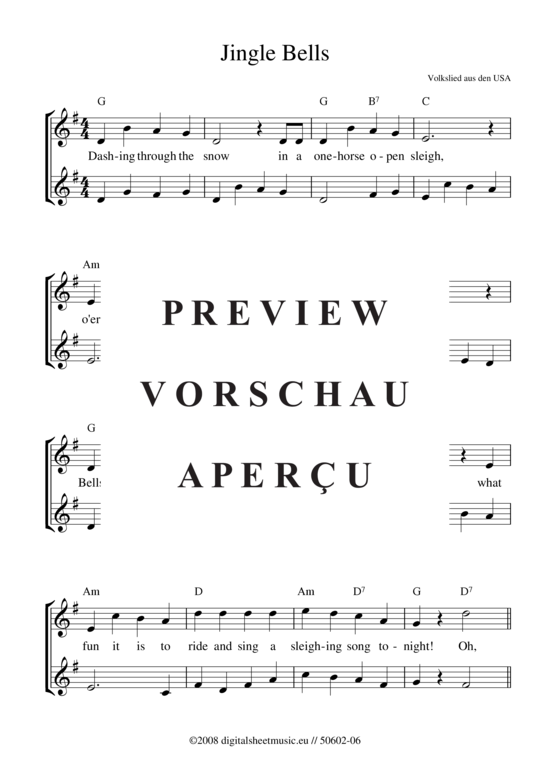
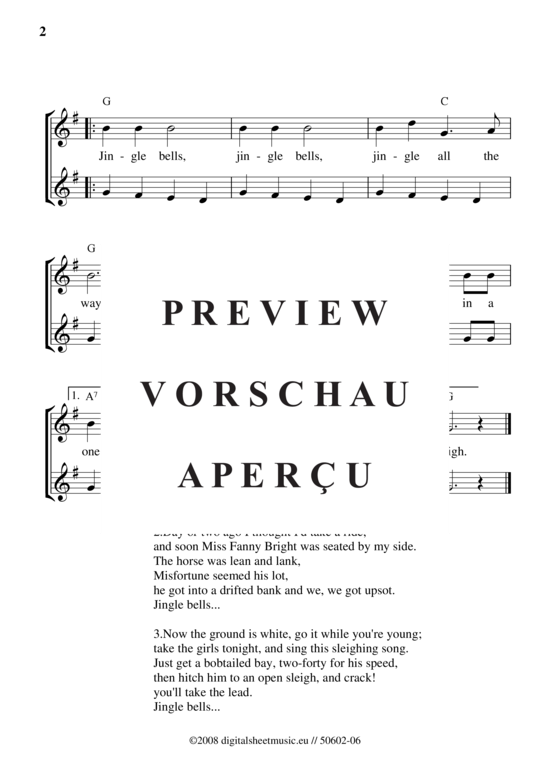
Details
| Product number: | 50602-06 pdf |
|---|---|
| Arrangement: | Duet |
| Instruments: | Flute |
| Genre: | Christmas |
| Duet: | Woodwind Duet |
| Difficulty: | Easy |
| Experience: | Beginner (1–2 years) |
| Key: | G Major |
| Language: | English |
| Tempo: | 160 |
| Authors: | Weihnachtslied |
| Pages: | 2 |
| duration: | 2:30 |
| Publisher: | ND-Verlag |
Jingle Bells - Sheet Music for Recorder Duet Weihnachtslied (sehr einfach)


 100% Legal & Licensed
 Verified by Musicians
 No Subscription. One-Time Purchase.
 Instant Download after Purchase
Details
| Product number: | 50602-06 pdf |
|---|---|
| Arrangement: | Duet |
| Instruments: | Flute |
| Genre: | Christmas |
| Duet: | Woodwind Duet |
| Difficulty: | Easy |
| Experience: | Beginner (1–2 years) |
| Key: | G Major |
| Language: | English |
| Tempo: | 160 |
| Authors: | Weihnachtslied |
| Pages: | 2 |
| duration: | 2:30 |
| Publisher: | ND-Verlag |
Product Description
"Jingle Bells" as a recorder duet – pure Christmas spirit that's fun from the very first note. These recorder parts are aimed at players with approximately two years of lessons under their belt. The wide interval leaps that define the piece demand a solid sense of pitch accuracy.
Sheet Music "Jingle Bells" – Spirited Christmas Classic for Recorder Duet
"Jingle Bells" is one of the most recognized Christmas songs in the world. The melody evokes a joyful sleigh ride through the snow – infectious, light-footed, full of momentum. What many people don't know: the song was originally written not as a Christmas carol at all, but as a Thanksgiving song. Today it's virtually inseparable from the Advent season – and in a duet arrangement, it comes to life in a particularly vivid way.
In this recorder duet, "Jingle Bells" has a clear division of roles. The melody part leads throughout the piece – spanning a range from the middle register up into the higher playing range, covering considerable ground. In the upper part of that range, approaching E5, it's worth paying conscious attention to embouchure tension: interval leaps into this register can easily cause intonation to drift sharp. The second part provides the harmonic foundation: the player taking this role is responsible for keeping intonation and tempo steady – a stable anchor around which the melody part orients itself. G major lends the arrangement brightness and directness – entirely diatonic, with no modulations or unexpected accidentals, making the key comfortable to navigate. The arrangement spans 26 bars with a repeat section. The tempo is brisk, which gives the piece its driving energy – and is also one of the reasons the wide interval leaps require focused attention. The arrangement deliberately avoids slurs across the leaps: staccato articulation gives the intervals clarity and suits the buoyant character of the piece.
- Main challenge: Interval leaps of a sixth and larger in the melody part, at tempo
  |
Practicing the leaps – sixths and larger – in isolation first, with deliberate attention to embouchure tension and staccato attack, will soon make them reliable at full tempo. The longer phrases of nearly six bars without a breath break are worth marking in advance: planning your breath points consciously allows you to carry the melodic line through smoothly, without breaking mid-phrase. Both parts should be rehearsed separately first – only once each part is secure on its own does playing together really pay off. From there, listen to each other regularly: in a duet, the interplay between the two parts carries the character of the piece. With its catchy, engaging character, this compact piece works well for a lesson setting or as a short highlight in an Advent concert programme.
A brief audio preview is available to listen to before purchasing – so you can get a first impression before you buy. The sheet music is available for immediate download after purchase. 100% licensed – ready to perform legally, right away.
Editorially reviewed by the notendownload.com team

Product Reviews