

 Orders
 Addresses
 Payment methods




Details
| Product number: | 5100007 pdf |
|---|---|
| Arrangement: | Duet |
| Instruments: | Piano , Trumpet |
| Genre: | Romantic |
| Era: | 19th Century |
| Duet: | Piano & Trumpet |
| Difficulty: | Easy |
| Experience: | Beginner (1–2 years) |
| Key: | G Major |
| Tempo: | 84 |
| Authors: | Silcher , Friedrich (1789-1860) |
| Pages: | 1 |
| duration: | 01:50 |
| Publisher: | ND-Verlag |
Ich hatt einen Kameraden - Sheet Music for trumpet + piano Friedrich Silcher (1789-1860)








 100% Legal & Licensed
 Verified by Musicians
 No Subscription. One-Time Purchase.
 Instant Download after Purchase
Details
| Product number: | 5100007 pdf |
|---|---|
| Arrangement: | Duet |
| Instruments: | Piano , Trumpet |
| Genre: | Romantic |
| Era: | 19th Century |
| Duet: | Piano & Trumpet |
| Difficulty: | Easy |
| Experience: | Beginner (1–2 years) |
| Key: | G Major |
| Tempo: | 84 |
| Authors: | Silcher , Friedrich (1789-1860) |
| Pages: | 1 |
| duration: | 01:50 |
| Publisher: | ND-Verlag |
Product Description
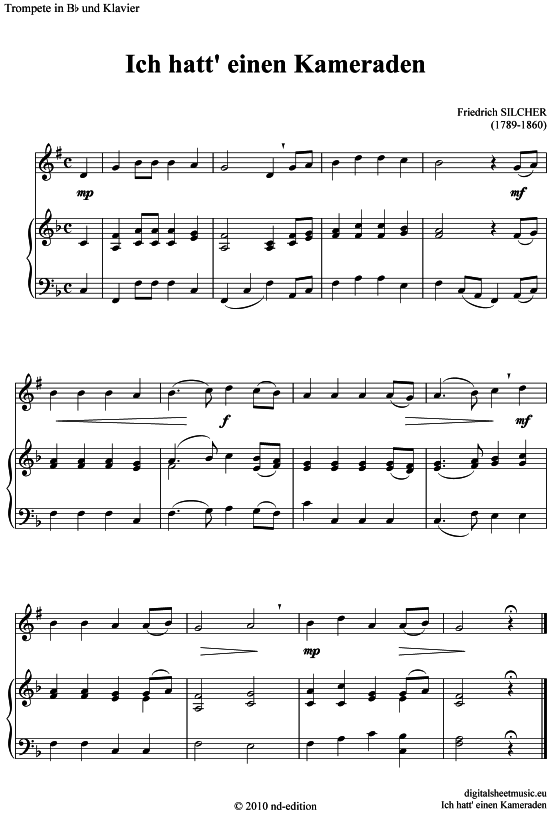
„Ich hatt einen Kameraden" is one of the most well-known funeral marches in the German musical tradition. On the trumpet, it sounds immediately like what it is: dignified and clear. The trumpet and piano parts are aimed at players with approximately two years of lessons; the piano accompaniment requires confident octave leaps and position shifts in the left hand.
Sheet Music „Ich hatt einen Kameraden" – Solemn Melody for Trumpet & Piano
Friedrich Silcher (1789–1860) was a Swabian composer and music director at the University of Tübingen, best known for his arrangements of folk songs. He set „Ich hatt einen Kameraden" to music in 1825, based on a poem by Ludwig Uhland — and the song went on to become the most recognized German melody of mourning. To this day it is performed at military commemorations and funerals, though it has long since taken on a broader significance as a song of farewell.
The trumpet part carries the melody in a register that sits idiomatically well for a B♭ instrument — the part is written in transposed notation, sounding a major second lower than written. The melodic arc spans exactly one octave, remaining comfortably in the trumpet's middle register. Particularly noteworthy is the phrase structure: a single melodic line extends across nearly eight bars without a break, which demands deliberate breath planning. The piano accompaniment is written in G major and is largely diatonic — with few chromatic departures — providing a calm, steady foundation beneath the trumpet. The clear dynamic contrasts between loud and soft give this brief piece (13 bars including the pickup) its inner tension.
- Range: d' to d'' (1 octave)
- Main challenge: Octave leaps in the left hand, position shifts in the left hand
- Ideal for: Memorial services, funerals, solemn occasions
- Tempo: Slow and sustained
 |
Practicing the left-hand octave leaps in isolation first — without the right hand, at a slow tempo — quickly reveals where the position shifts occur and allows you to work on them deliberately. The delicate legato phrasing — short slurs that each encompass a small melodic group — works best when trumpet and piano coordinate their breaths and phrase endings together: where a phrase concludes, there is room to breathe. The dynamics depend on genuine contrast — a piano that is truly quiet makes the difference between a plain performance and one that moves the listener.
The sheet music is available for immediate download after purchase. 100% licensed — ready to perform legally, right away.
Editorially reviewed by the notendownload.com team
