

 Orders
 Addresses
 Payment methods




Details
| Product number: | NOD-3739405 pdf |
|---|---|
| Arrangement: | Duet |
| Instruments: | Piano , Vocal |
| Genre: | Barock |
| Duet: | Piano, Voice |
| Vocal: | Low Voice |
| Difficulty: | Easy |
| Experience: | Beginner (1–2 years) |
| Key: | C Major |
| Language: | Italian |
| Tempo: | 60 |
| Artist: | Parisotti , Alessandro |
| Authors: | Giordani, Giuseppe |
| Pages: | 3 |
| duration: | 03:11 |
| Publisher: | Xavier Palacios |
Caro mio ben - Sheet Music for Low Voice and Piano Giuseppe Giordani








 100% Legal & Licensed
 Verified by Musicians
 No Subscription. One-Time Purchase.
 Instant Download after Purchase
Details
| Product number: | NOD-3739405 pdf |
|---|---|
| Arrangement: | Duet |
| Instruments: | Piano , Vocal |
| Genre: | Barock |
| Duet: | Piano, Voice |
| Vocal: | Low Voice |
| Difficulty: | Easy |
| Experience: | Beginner (1–2 years) |
| Key: | C Major |
| Language: | Italian |
| Tempo: | 60 |
| Artist: | Parisotti , Alessandro |
| Authors: | Giordani, Giuseppe |
| Pages: | 3 |
| duration: | 03:11 |
| Publisher: | Xavier Palacios |
Product Description
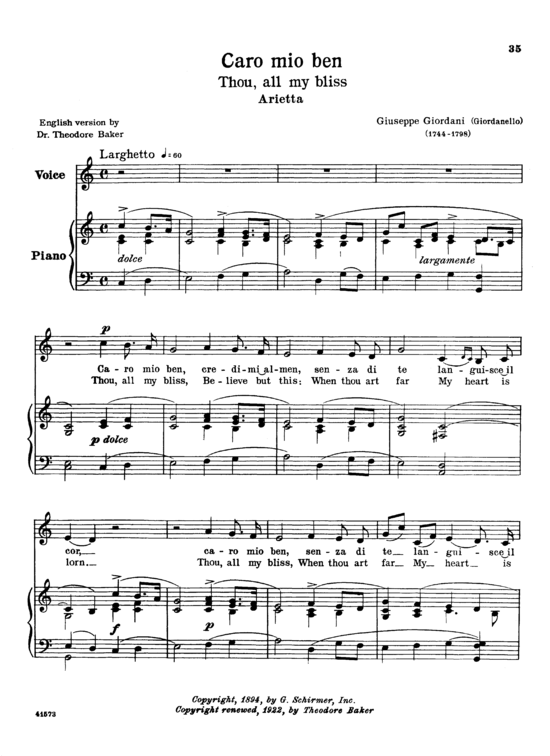
"Caro mio ben" ranks among the most celebrated arias of the 18th century — and this edition for low voice and piano makes it accessible after approximately two years of study. The piano accompaniment is particularly demanding in the left hand: octave leaps and position shifts require solid technique, even though the unhurried tempo leaves room to breathe.
Sheet Music "Caro mio ben" — Cantabile Baroque Aria for Low Voice & Piano
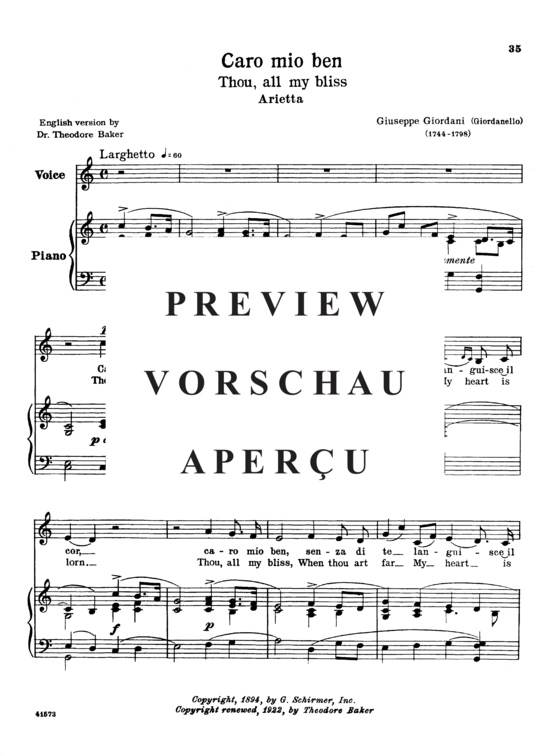
"Caro mio ben" is attributed to Giuseppe Giordani and appeared in this form in Alessandro Parisotti's influential anthology "Arie antiche" (1885), long considered a standard reference in classical vocal pedagogy. The aria explores longing and separation — a mood that permeates the vocal line directly and aligns with the Baroque doctrine of the affections: music should express a clearly defined emotional state and evoke it in the listener. This edition is arranged for low voice in C major and was originally published by G. Schirmer.
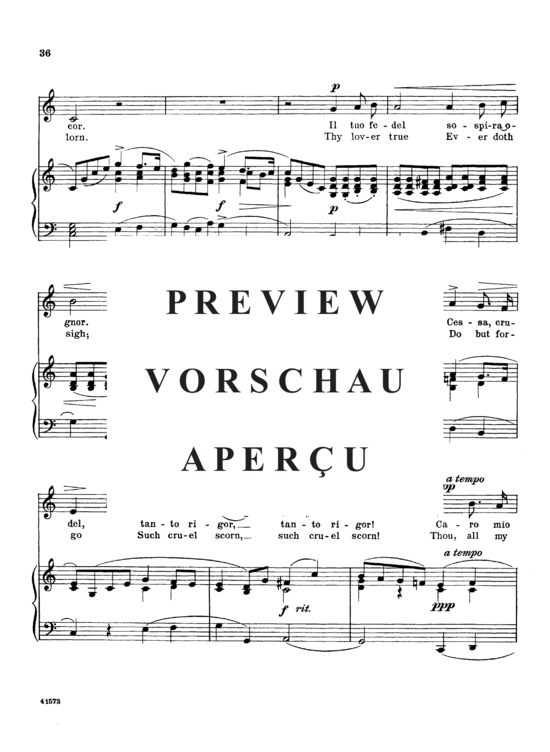
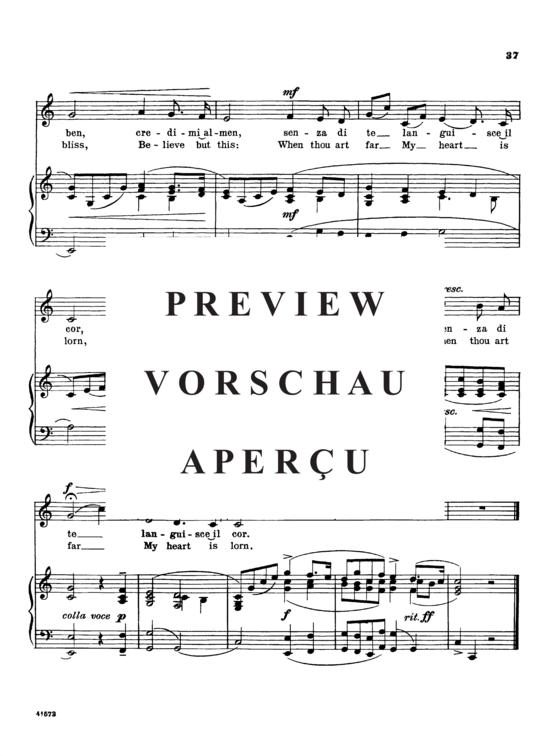
The vocal part moves within a moderate range — just over an octave — remaining well centered for a low voice without venturing into extreme registers. The delicate legato phrasing — numerous short slurs that carefully connect each note to the next — is the defining vocal-technical feature of this aria, reflecting the Baroque practice of shaping affect through deliberate slur placement rather than through an unbroken wash of sound. The piano accompaniment is consistently diatonic — meaning no chromatic inflections, strictly within the scale degrees of the key — which aids orientation considerably. In the course of the aria, a modulation to G major occurs, the dominant of the home key; it functions not as a harmonic rupture but as an organic brightening that briefly opens up the texture before returning to C major. The overall difficulty remains light, as the key and harmonic language are straightforward; the real challenge lies in coordinating both hands, particularly when the left hand leaps.
- Vocal Range: B to d''
- Primary Challenge: Octave leaps in the left hand of the piano accompaniment
- Additional Challenge: Left-hand position shifts when alternating between bass notes and chords
 |
Practicing the left-hand octave leaps alone — without the right hand — quickly reveals exactly where the position shift occurs, allowing you to work on that moment in isolation before bringing both hands together. The short legato slurs in the vocal line demand that each phrase genuinely sounds connected: not as a continuous flow, but as a succession of small, self-contained arcs. A common beginner's mistake is to ignore the slur boundaries and sing the entire line as one unbroken legato run — this blurs the phrasing structure and strips the aria of its characteristic sigh-like gesture. Breath points fall naturally at the slur boundaries — that is, at the end of each short legato slur, just before the next begins. Consistently honoring these phrasing pauses means breathing with the music rather than against it: the breath fills precisely the gap that the phrasing already implies. The piano supports most effectively when it follows the dynamic contour of the voice — drawing back where the voice carries, stepping forward in the transitions.
A short audio preview is available in advance — useful for getting a feel for the tempo and character before downloading the sheet music. The score is available for immediate download after purchase. 100% licensed — ready to perform legally, right away.
Editorially reviewed by the notendownload.com team
